Little is known of the early life of Arthur Osborne’s Grandfather William Monk, who was born in 1796, but we do know that he had a varied career. In the recorded baptisms of his four children his occupation is given as a Cooper of Davington. This was probably at the gunpowder works in Oare because we find his next employment is as a clerk there, and later becoming the Manager, later still he is a brick maker and property developer.
In 1837 William bought the sailing barge Industry (54 tons, built at Bankside in 1825). He began his career as a local property developer in 1846 by rebuilding 9 Market Street Faversham whilst still Manager of the gunpowder works
In October of 1847 he bought premises at 44-45 Court Street in Faversham, from Zachariah Warren’s widow, Martha, for £330 as well as taking over a £500 mortgage, and it was here that his son (Arthur’s father), Frederick William Monk, started work, at the age of fifteen, as a bookseller and printer. For a while, Court Street became ‘The’ area for bookshops.
In 1850 William Monk bought the site of 1 to 13 Albion Terrace (now 11-13 South Road) and developed it for housing, he remained the owner of all the houses until his death. At this time, William Monk was living with his wife and three surviving children (two sons had died in infancy) at The White House, Oare, Davington.
In mid-1855 William Monk sold his printing business to a John Sherwood, who announced in the Faversham and Sittingbourne Gazette of July 2nd 1855, that he was shortly moving to Court Street.
Frederick William Monk had followed his father’s example, at some time around 1855 and also became a property and landowner [census 1861]. He had married a local girl, Jane Dan, in the Spring of 1854.
When Arthur’s birth was registered on the 20th of August 1855, Frederick William Monk gave his occupation as “gentleman, of Ospringe Road” and in 1861 he is recorded as a property owner [census 1861] at that time living at 7 Albion Terrace, Faversham. His parents, William and Elizabeth Monk, were living at number 3.
Freed from the mundane chores of bookseller and printer, Frederick threw himself into parish affairs, being elected as a borough Councilor in 1859 and becoming Mayor in 1862 and again in 1863 [Faversham Mercury: 1862-1863]. He is mentioned as active in Faversham Institute affairs from early 1855 being its vice-president in 1856 and president in 1857.
Also in 1857, William Monk commissioned the sailing barge Harriet (34 tons) from John Mathew Golfinch of Faversham. This sailing barge was to blow up in an accident at the powder magazine of William Hall at Erith on the 1st of October 1864.
Land for the new Faversham Institute building was sold for £200 to the Institute Management committee by William Monk in 1861 and he developed Newton Terrace on either side of the new Institute building; the new Institute opened in June 1862. At this time William was living at 3 Albion Terrace with his wife Elizabeth, daughter Julia, and two domestic servants.
Frederick William was also the builder of some of the more imposing buildings in the town, including the block at the junction of Preston Street and Market Street, (Geerings and J High, opticians), the three-story part of Lloyds Bank and some of the residences in Albion Terrace, South Road, in one of which he lived.
Frederick William Monk’s parish involvement reached its peak between 1863 and 1864: director of the Faversham Water Company and secretary of the Faversham Horticultural Society from 1863; and chairman (and director) of the Faversham Cattle Market Ltd in early 1864. He was from July 1864 the secretary of the Kent Association of Institutes.
In 1866, along with his son Frederick, William Monk commissioned construction of the sailing barge Star (37 tons) built by J Goldfinch of Faversham, and in the same year, also in a joint venture, commissioned construction of the sailing barge Breeze (38 tons) again by J. Goldfinch.
Both William and Frederick William Monk had run into financial difficulties in 1867, if not earlier. Frederick William Monk resigned as managing director of the Faversham Institute early in 1867 and as the secretary of the Kent Association of Institutes later in the same year. The sailing barge Star was sold on the 15th of July 1867 On the 22nd of November 1867 William Monk conveyed 44-45 Court Street to his son’s father-in-law, Osborn Dan, who had agreed to purchase the properties for the sum of £2000 and also take over of the mortgage of £500.
Both the sale of the Court Street properties and the cessation of references to Frederick William Monk in the Faversham Institute Monthly Journal seem to suggest that he left Faversham sometime after 1867.
By 1869 the family were living at 14 Oxford Terrace in Clapham Road, London where their sixth daughter Gertrude was born on the 3rd of December.
On the 11th of January 1869 William Monk died, leaving his estate to his widow Elizabeth, now residing at Upper Norwood Surrey.
In early March William Monk’s creditors began proceedings in respect of his debts and on the 20th of March a court order was made against Elizabeth and F.W Monk for William Monk’s estate to be applied in discharge of debts he had incurred through the partnership of Monk and Son.
Frederick William Monk sold the sailing barge Breeze on the 4th of July 1869 and in that same month was made bankrupt.
From the London Gazette:
Frederick William Monk, surviving partner of William Monk, and the said Frederick William Monk lately carrying on business in copartnership at Davington, near Faversham, in the county of Kent, and No.2 Bouverie Street in the city of London, as Brickmakers and Dealers under the style or firm of Monk and Son, and residing at Norwood, in the county of Surrey, Brickmaker, Dealer and Champman, having ben adjudged bankrupt under a petition for adjudication of Bankruptcy, in London, on the 5th day of July, 1869, is hereby required to surrender himself to the Registrar of the said Court, acting in the prosecution of the said Petition, at the first meeting of the creditors to be held before the said Registrar, on the 22nd day of July instant, at one o’clock in the afternoon precisely, at the said Court. Mr. Peter Paget, No. 22 Basinghill Street, London, is the Official Assignee, and Messrs. Kingsford and Co. of No. 23 Essex Street, Strand, are the Solicitors acting in the Bankruptcy.
On the 27th of October in the same year, FW Monk made application as a Bankrupt for the discharge of his debts. An Order of Discharge was granted by the Court of Bankruptcy on the same day.
A Dividend meeting under both the joint estate and the separate estate of FW Monk was arranged for the 19th day of January 1871. On the 16th of May 1871 a First Dividend at the rate of 3s 3d was now declared payable to creditors upon proof of the debt owing.
There appears to have been no record of any further or final dividend being paid.
In the London publication ‘The Antiquary’ for 4th of January 1873 there appeared a prospectus for the sale of shares in The London Co-operative Printing and Stationary Company Ltd. This prospectus in its preamble stated that: “This Company is projected for the purpose of acquiring a large and well-established printing business in the City of London, and for carrying on and extending the same in accordance with the principles of sound co-operative trading. A provisional agreement dated the 8th day of November, 1872, for the sale and purchase of the same, has been entered into between William Wilfred Head and James Hole of the one part, and Frederick William Monk, on behalf of the Company of the other part;…”. The secretary of this enterprise was Frederick William Monk of 176 Fleet Street. The Company printed ‘The Antiquary’ from 11th January 1873, and its imprint from the 24th of May was “published for the proprietors by Frederick William Monk. 81a Fleet Street”.
There the trail of Frederick William Monk ends.
It is said that Frederick William Monk emigrated with his family to America and changed his surname to Osborne (after his father-in-law Osborn Dan). No evidence has been found to support this claim, apart from the fact that his son returned to Faversham as Arthur Osborne and died as such. **
*Excerpts from Faversham Papers No 51 by Richard Goulden, with later additions in 2003.
** Research since 2001 now enables us to update this information.
In the 1871 census the Monk family were recorded as living at number 12 Dalyell Road, Brixton, Lambeth, and Frederick Monk’s occupation is shown as Auctioneer. At this time three of the Monk children Marion, Clara and Reginald, were staying at their Uncle Issac Dan’s home, 23½ Preston Street, Faversham.
Also in the 1871 census, Frederick’s mother was still alive, an annuitant, and living as a lodger along with her Governor daughter, Julia, in the home of a builder in Norwood, Surrey.
On the 8th of October, 1874 the partnership of William Wilfred Head and James Hole, printers, was dissolved by mutual consent, no mention of their former partner FW Monk was made.
In 1874 Jane Monk, who was now known as Mrs. Osborne travelled with her twelve-year-old son Frederick and five-year-old daughter Gertrude from Liverpool to Quebec, Canada, onboard the steam-sailing ship ‘Peruvian’, arriving at Quebec on the 6th of September 1874.
Nine months later, in 1875, Elizabeth, Marion, Ellen, Clara and Reginald Monk (also known now as Osborne) travelled under the guardianship of a Miss Dan from Liverpool to Quebec, Canada onboard the steam sailing ship ‘Dominion’, arriving at Quebec on the 24th of June. It would seem, most likely, that Miss Dan was in fact Sarah Dan, their aunt.
It is not known whether Frederick Monk and his son Arthur had preceded these two voyages to Canada or had followed shortly after. Their movements after 1875 are not known, but as a family group they made their way into America, and would appear to have been in the Boston, MA area circa 1877.
Frederick Monk, his wife, and children next appear in the 1880 census for the Boston, Massachusetts area, living at number 7 Riverside Square in Hyde Park, where Frederick Monk is listed at F.W.A. Osborne. (The ‘A’ had probably been added to distinguish him from his son who had the same Christian names).
F.W.A. Osborne’s occupation was described as ‘Author’ while that of his two oldest sons was shown as ‘sculptors’. The youngest son, Reginald, was still at school. By 1882 F.W.A. had bought property in the area and by 1884 both Arthur and his brother owned real estate in Hyde Park.
On August the 1st 1884 Frederick William A. Osborne died from a stroke at the age of just 52.
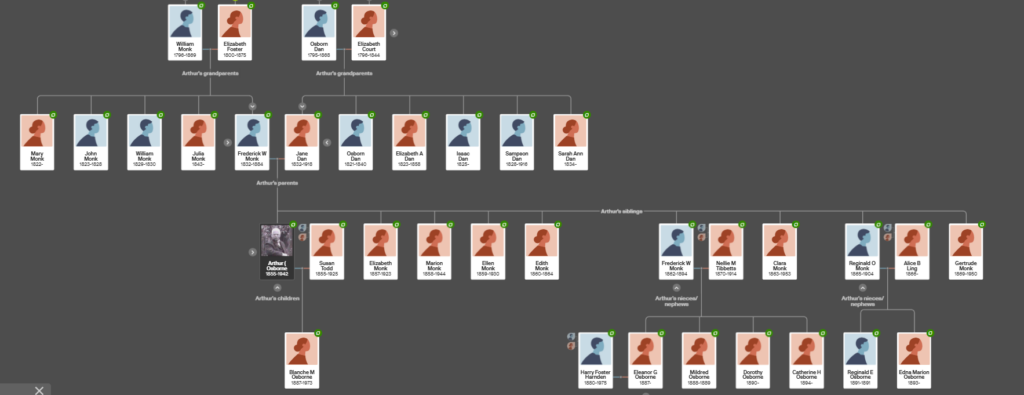
On April the 25th 1885, Arthur Osborne married Susan Todd and in 1887 a daughter Blanche Marguerite was born. Prior to that birth was another marriage, when on October the 20th 1886 Arthur’s brother, Frederick William, married Nellie M. Tibbetts, who had been born in Lawrence, MA. Nellie gave birth to four daughters, all born in Hyde Park. They were Eleanor Gertrude (1887), Mildred (1888, who sadly lived for less than a year and died of gastric enteritis on August the 23rd 1889), Dorothy (1890) and Catherine Hazel (1894). There might have been more but for the untimely death of their father Frederick in Andover, MA. He died on the 9th of April 1894 of typhoid fever and was buried in Spring Grove Cemetery, Andover on the 13th of April 1894.
Nellie then married 30-year-old Ralph Kimball in Haverhill, MA but no more children were born.
By the time of the British census in 1891 Arthur Osborne’s mother and all of his sisters had returned to England, while he and his two brothers remained in America.
Reginald O. Osborne married Alice B. Ling in Boston, MA on the 22nd of November 1890 and in 1891 a son, Reginald E. Osborne, was born only to die that same year. The couple left America in 1892/3 and moved to Norfolk, England where their daughter, Edna Marion, was born in 1893. Later they settle in Faversham, Kent. Reginald died in an industrial accident in 1904 and on the 5th of May 1908 his widow, Alice B Osborne, and their daughter, Edna Marion, boarded the Cunard ship ‘Ivernia’ and returned to Boston, Massachusetts.