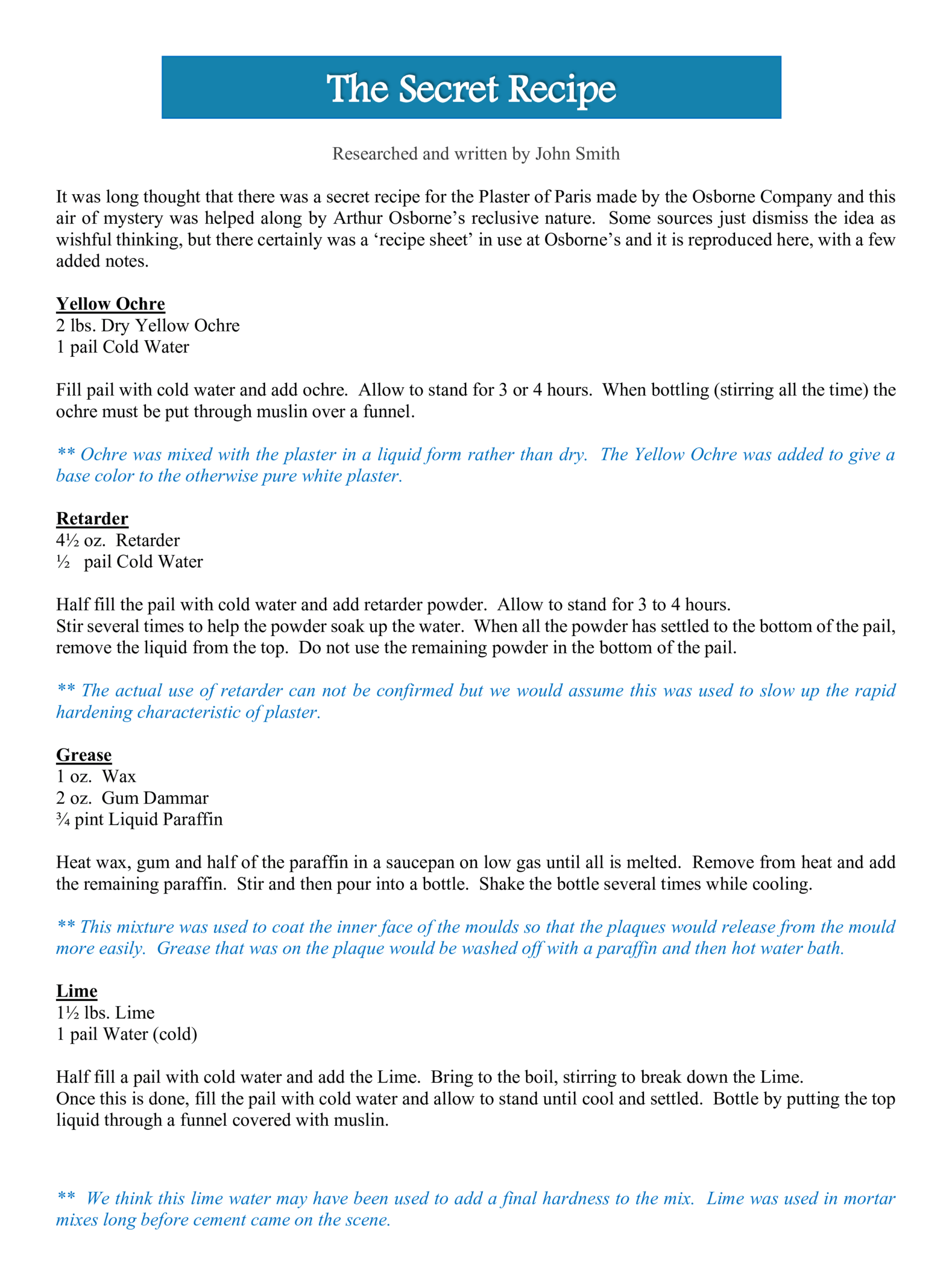
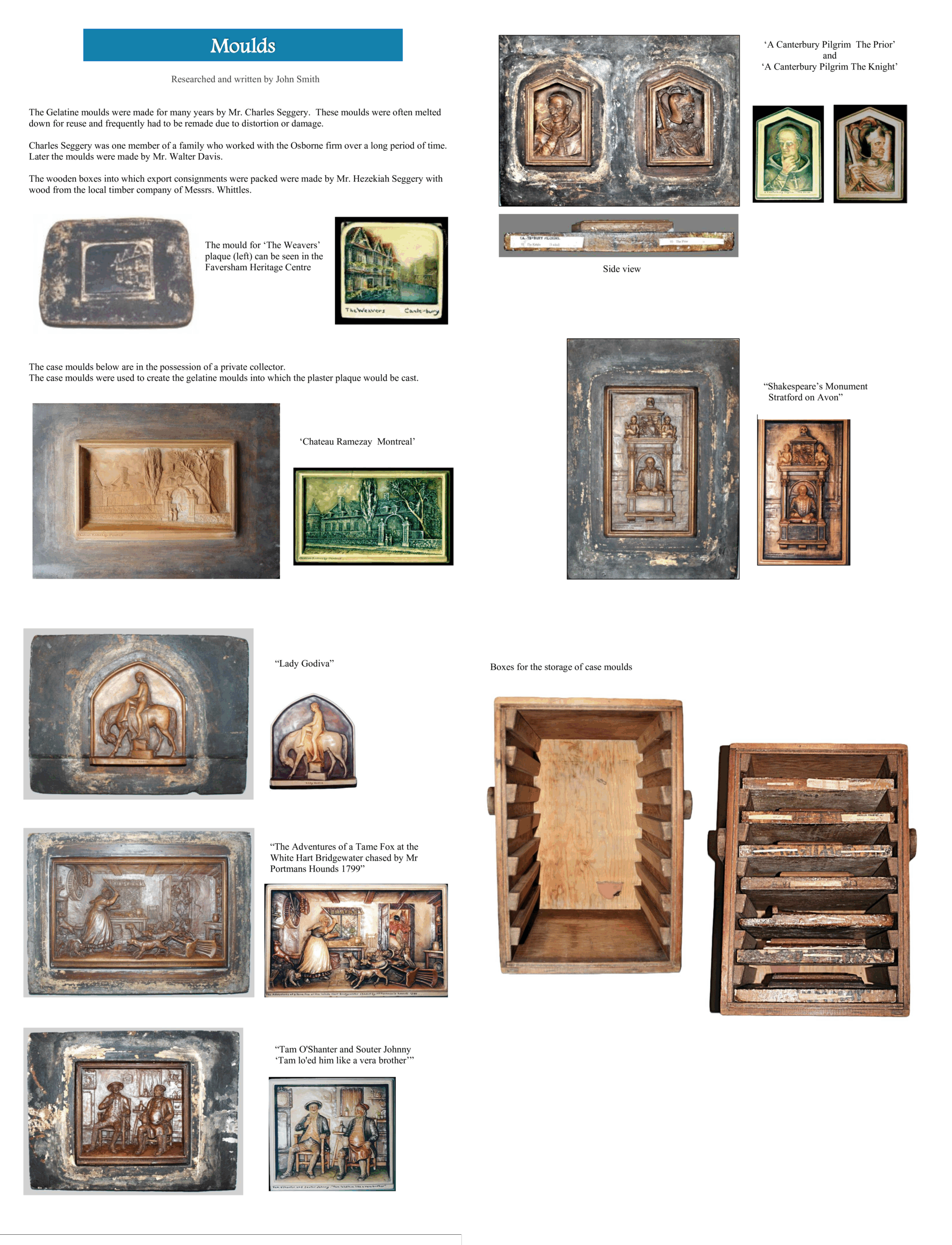
Having created a rough drawing from a postcard, divided into a grid reference to enable precise positioning, a scene would be sculpted on a flat slab of clay (later Plasticine would be used because of the problems of keeping clay continuously moist). Over this scene would be placed a case mould, sort of a box with five holes in the top surface. Into this would be poured the liquid gelatine and the whole thing would be left overnight for the gelatine to harden. The next day the case mould would be removed and the gelatine mould pulled from the case. Using this mould a plaque would be cast in plaster. Once hardened the plaque would be removed from the mould and reworked with small tools to put in fine details such as windows and the ‘cutting in’ of the titles. Once happy with the scene the case mould would be used again to make new gelatine moulds for production use.
Plaster arrived at 83 Abbey Street in one-hundred weight sacks, brought by the railways from Stoke on Trent. This would be sifted through a silk screen tray to remove any lumps and foreign material and would then be ladled out into mixing bowls. At the start of each day Mr. Seggery would make up a batch of Yellow Ochre for the body colour by carefully measuring out the powder in order to maintain colour consistency and mixing it in a large stone container with lime water and retarder. This mix would then be used to mix with the plaster. The dry powder mix would then be shattered into the mixing bowl of water until it came to the top. Each bowl would hold enough for three moulds, one large and two small: this being a reasonable weight for the girls to handle.
Once mixed, the bubbles would be skimmed from the top and the liquid plaster poured into the moulds. The method was to start at the bottom right corner, jiggle across to the top opposite corner and once there, to jog it to settle the mixture into the crevices. This would be done for another two moulds and once they were filled it would be back to the start to skim off any more bubbles, going through all three and then back to the start again with a brass straight edge to smooth and finish the backs. Once done, the next three moulds would be poured.
In the casting room there were three girls, and they would have six moulds each. Once removed from the moulds the plaques would go into a bath of paraffin, then into a bath of hot water to remove grease (prior to pouring the plaster the inside of the moulds were brushed with a special paraffin wax mix to prevent them from sticking to the plaques).
The plaques would then go into a small pulley lift capable of carrying 60-80 pounds up to the next floor. This was an idea from Walter Davis, suggested when Mr. Osborne was seeking a way of improving the work method. Previously the plaques would have been carried by the girls up two flights of stairs to the drying room.
In the drying room was a large turtle stove that was kept alight through the night, heating the room and drying the plaques. Mr. Osborne slept in a room above the workshop in the early days and so tended the stove.
Once dried and hardened the painting process would begin. The first stage was blacking up, where the plaque would be immersed in water, taken out and the scene painted with a wash of black. This would be dipped again and then the high points of the scene lightened up to show up the modelling. The plaque was then allowed to dry. Blacking up was done while the plaque was wet and colouring was done when dry. The colours themselves were applied with plenty of water in more of a wash than actual painting.
The plaques would again be dried and when dry the backs and corners would be smoothed and finished in the cleaning room and the trademark ink stamped on the back. In the early days prior to the rubber stamps the date and copyright would be cut in on the backs.
Around six-thirty in the morning the first of the girls in the waxing room would come in and light the fire under the two paraffin wax tanks. Each of these was a tank within a tank, wax in the inner tank and water in the outer tank, much like the old fish glue pots that carpenters used, but of course much larger.
Once up to the correct temperature of 166-170 degrees the plaques would be gently floated in and left for six or seven minutes. The wax would quickly soak in and once the air bubbles had stopped coming to the surface, the plaques would carefully be removed and stood up on wooded slats to allow the surplus to run off.
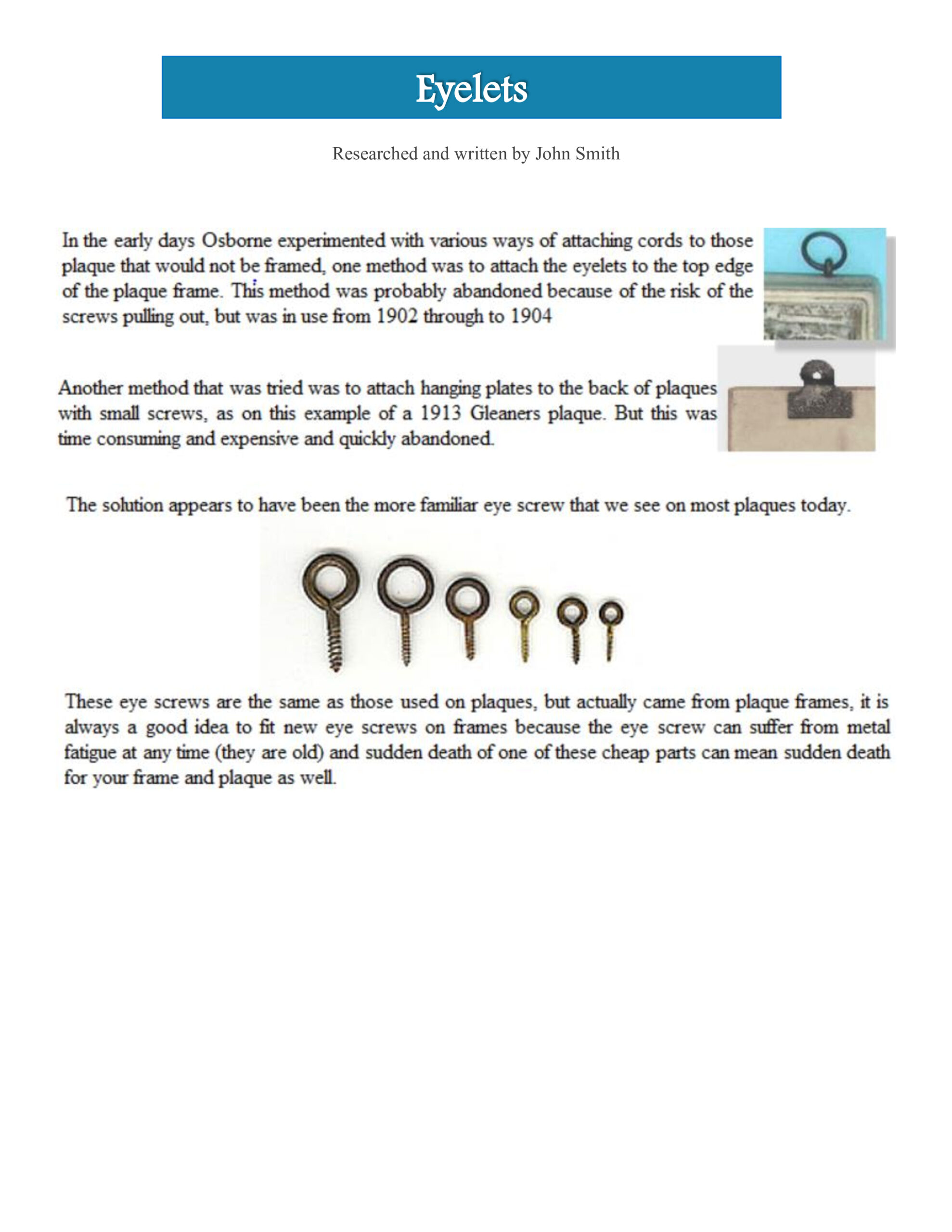
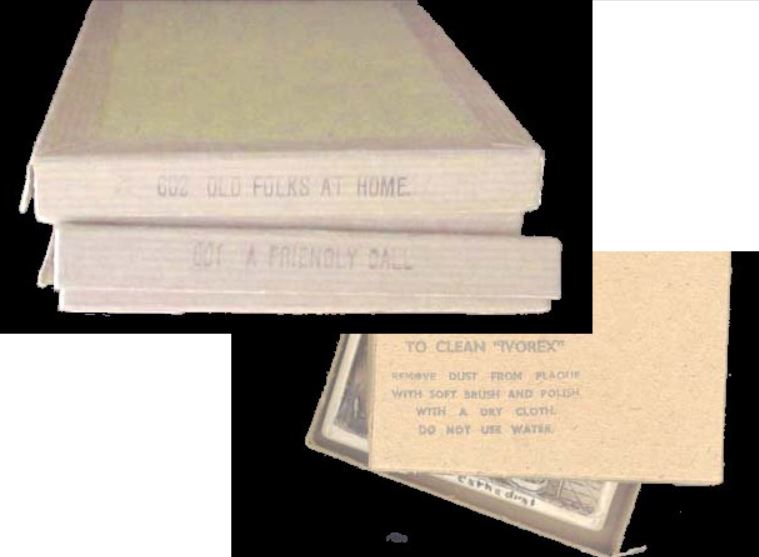
From there it was off to the polishing room where the plaques were buffed to a nice shine and the holes drilled in the cameos for cords and in the backs of the larger plaques for screw eyelets. In the early days an Archimedean drill was used for this operation but later a power tool with a limited depth drill was used. The plaques would then be wrapped in tissue paper and placed into individual boxes.
These boxes were all tailor made in Maidstone to match the size of the plaques, just a one-inch difference in a plaque size meant a requirement for a new box. Each box added between a penny and five pence to the cost of a plaque depending on size. The boxes would be delivered by a van, two or three thousand at a time, bundled into lots of 24. These would be carried by the girls up three flights of stairs for storage in the four attics of 83/84 Abbey Street. This was a job that would take all of an afternoon.
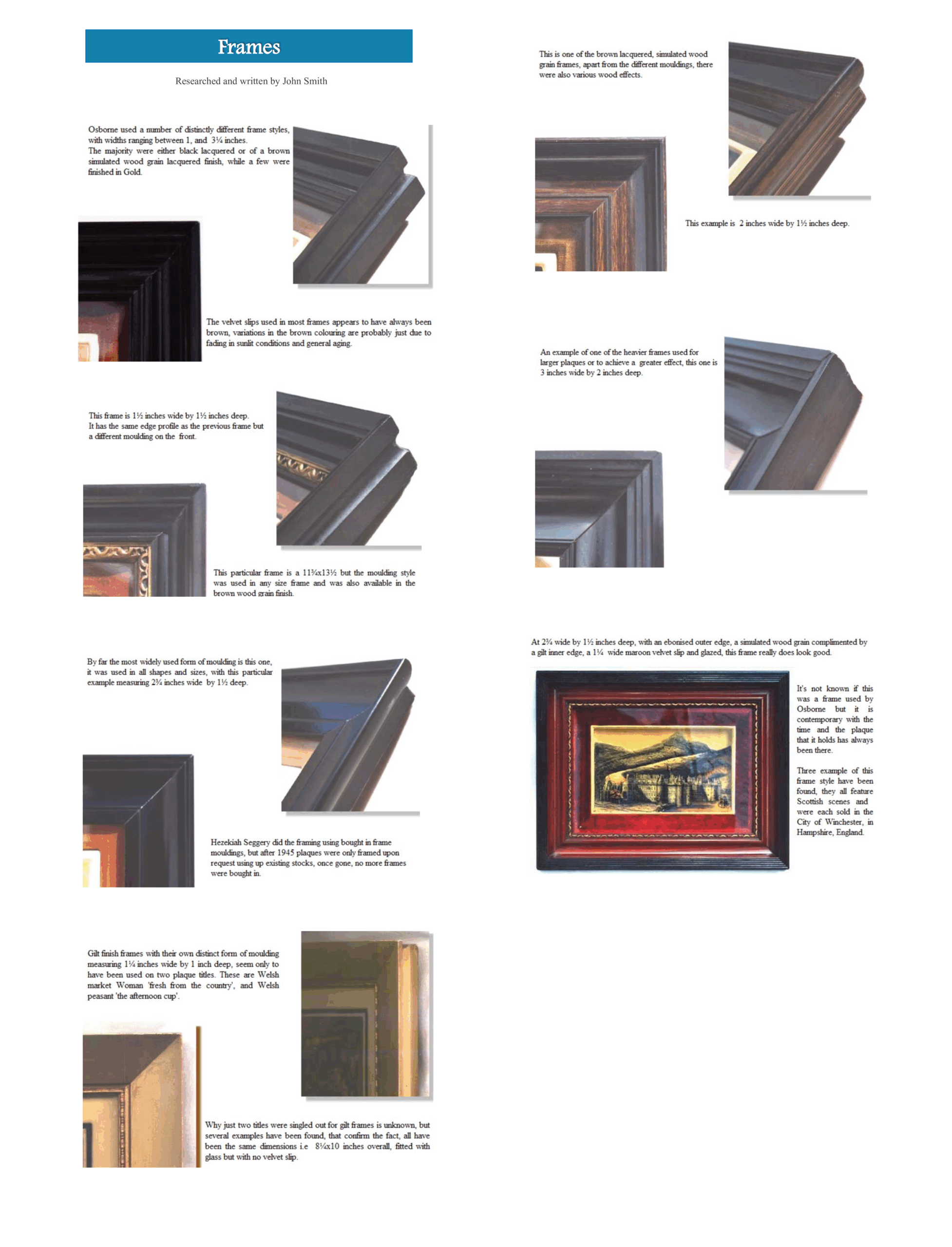
Prior to the second world war a large number of plaques were placed in black lacquered frames, the long lengths of frame moulding can from either Italy or Norway and was made up into custom built frames by Hezekiah Seggery. During the war this material was unavailable, and a similar English moulding was tried but proved to be of a poorer quality with cracking and flaking of the lacquer occurring, so rosewood frames were used for a while until eventually all plaques were sold unframed.
The next stage was shipping and for this tea chests were used, an average of 180 could be packed into a tea chest costing just sixpence. On the export orders something more sturdy was required and cases would be constructed by Hezekiah using rough sawn timber purchased from the local timber merchant, Messrs. Whittles. The plaques would be packed into these cases using specially purchased wood wool to act as padding and protection. This was the only material allowed under export/import restrictions.
The last shipment to the United States of America consisted of four cases each holding 180 pieces of ‘The Old Folks at Home’, ‘A Friendly Call’, ‘Ann Hathaway’s Cottage’ and ‘Shakespeare’s House’, at a wholesale price of just two shillings and six pence per plaque.
For additional information click the links below: