Some Osborne plaques have been around now for over a hundred years; their survival for the next one hundred years depends largely on what you do now.
Here are a few tips that may help ensure a lengthy life.
FRAME IT
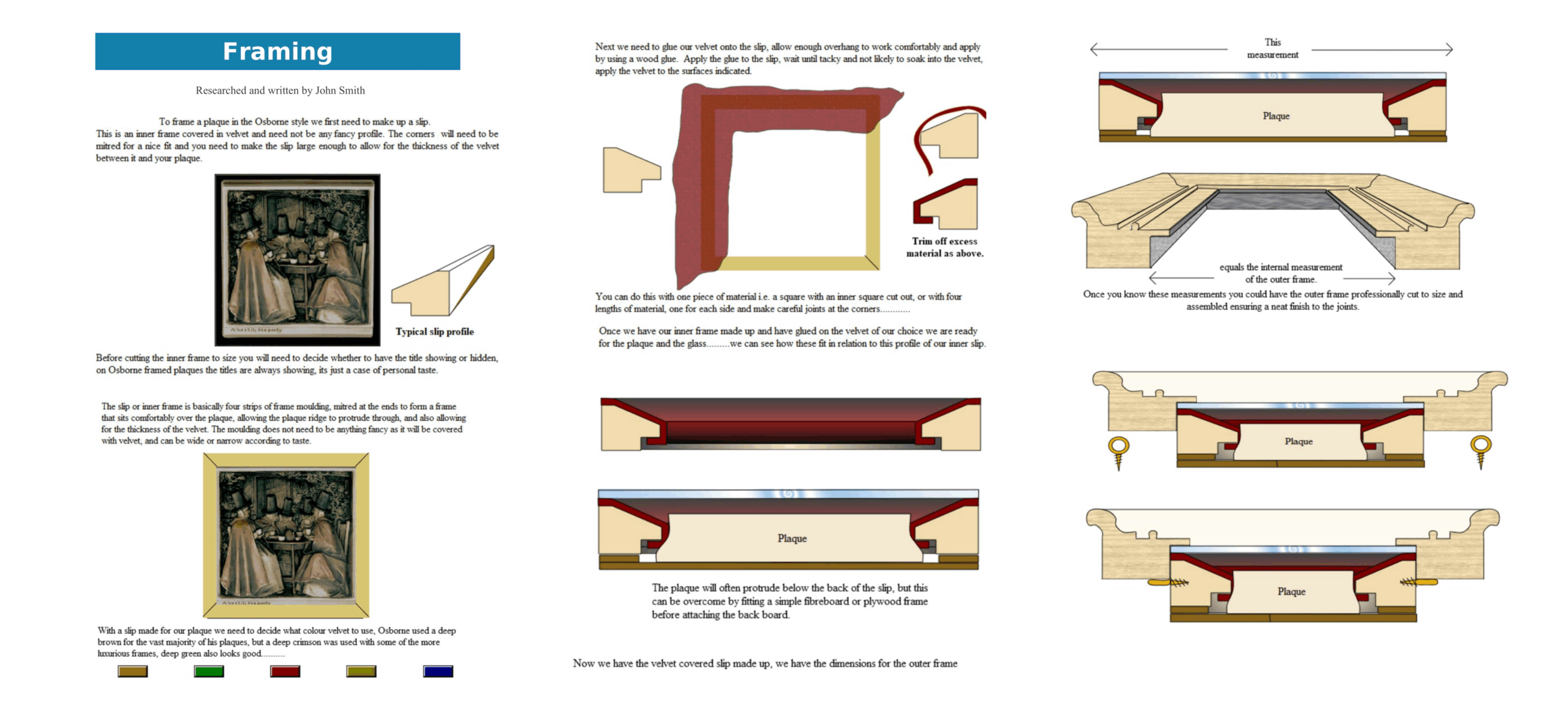
If you have one of the larger plaques, or a special favorite, an ideal way to protect it, as well as improving the display, is to frame it – especially if you frame it according to the Osborne method. This will keep it clean and help to protect it from damage. You could do this yourself or have it done professionally.
LOOSE EYELETS
The eyelets on the back of the larger plaques are often found to be loose, but these can be refixed by using an epoxy resin adhesive to glue them in. If the eyelets are not loose then do not attempt to remove them. If they are broken off leaving just a stub in the plaque, you could carefully drill new holes above the old ones and insert new eyelets.
An alternative would be to use a plate stand for display purposes.
OLD CORDS
On a lot of plaques can be found the original cord or wire. Whilst the cords seem fine on the smallest plaques, it is a good idea to fit replacement cords or wire on the larger and framed plaques.
If you are not going to hang your plaques, then leave the original cords intact.
CLEANING
We have heard of folk using soap and water to clean plaques, and from the look of some that we have seen a scrubbing brush too. Water was a major component in the manufacturing process but is best kept away from plaques now. There only needs to be a small chip in the waxed outer layer and the plaque will soak up water like a sponge, leading to deterioration of the dampened area.
The method we use to clean plaques is by using a hard wax polish; we use a clear wax that is silicon free. A soft cloth and small circular motions will lift dirt and grime from the surface. Care should be taken however, as some of the black that is appearing on the cloth could be paint. It is all too easy to remove the top coat of wax and then be cleaning away the painted surface. Once the dirt has been removed you can buff up the surface to bring back the original shine.
Discoloration from coal tar, i.e. smoke from coal fires and tobacco smoke does not appear to be removeable by this method and is perhaps best left alone.
If your plaque is framed the chances are that the paper backing has never been disturbed, and if you intend to see the plaque on, that is the best way to keep it. But framed plaques do get dirty, though in this case it is only the glass that gathers dirt (even on the inside), and the glass can easily be cleaned. This is often the dilemma time as one hesitates to open up an untouched back, but if you want to see the scene as Osborne intended, you have no choice but to open it and clean the glass.
Osborne’s own instruction for cleaning plaques, often printed on the box was, “Remove dust from plaque with a soft brush and polish with a dry cloth. Do not use water.”
LIGHT AND SHADE
Temptation tells you to place your plaques on a brightly lit wall where they will look their best and the full glory of the colours will shine forth. Beware, those are watercolours and they will fade in bright sunlight, even the paraffin wax coating will deteriorate under these conditions.
An indirectly lit wall, away from central heating radiators will suffice and the colours will last a long time.
DISPLAY
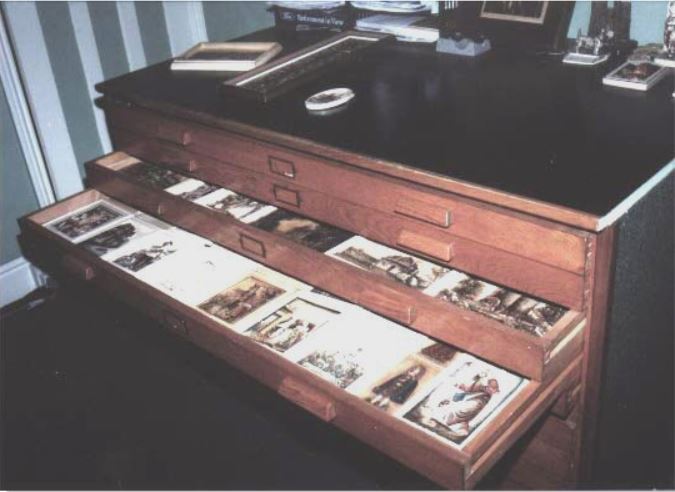
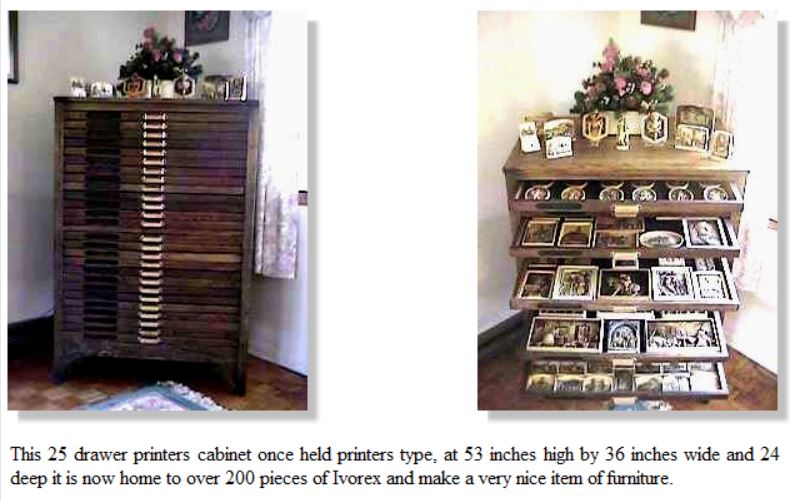
Plaques look their best hung on the wall, or on a shelf using plate stands, but this depends on mathematics, which is larger, your wall space or your collection. A good method of display/storage is to use a plan chest, or printer’s cabinet. These are chests of shallow drawers, usually containing between six and twenty drawers that were made to hold drawings, plans or printers’ type.
The shallow drawers are ideal for laying out a collection and a fair number of plaques can be displayed in each drawer; you could even arrange your collection according to categories. This is also the ultimate in keeping clean and preventing fading by sunlight.
Plan chests can be bought new from office suppliers or second-hand from sellers of used office equipment. They can be found made of metal or wood, usually oak or mahogany.
ORIGINAL FRAMES
The original black lacquered frames can use their gloss and take on a brownish sheen from years of exposure to cigarette and coal fire smoke. The best way to remove this brown coating and restore the black gloss is to use a black shoe polish … not the liquid wipe-on type, but the old wax type.
Rub it on gently with a soft yellow duster. This will remove the dirt and impart a layer of wax. Leave for a while and then buff to a shine, going over again any places you have missed. The wax shoe polish is not abrasive, so no harm is done to the lacquered finish.
Extra case should be taken if the lacquer finish has cracked and perhaps flaking off. Any loose pieces should be re-attached using one of the instant super glues. The black polish will fill cracks and help disguise this defect.
Take a careful look at the back of the frame. It is usually a good idea to renew the old wire or cord with new, heavy-duty picture wire and possibly screw in new eyelets; the original could be getting close to a hundred years old and about to fail.