Elizabeth and Clara
Elizabeth and Clara Osborne
Researched and written by John Smith
Within the story of Arthur Osborne and Ivorex plaques, we should take a moment to ponder the words ‘Copyright E and C Osborne’. E stands for Elizabeth and C stands for Clara, and they were two of Arthur Osborne’s five sisters.
They had returned from America to Faversham some years before Arthur, and initially resided, along with their sister Gertrude, with their aunt and uncle in East Street, Faversham. At a date that is unknown to us they moved to the Dane John in Canterbury and set up a shop close to the Cathedral, where they sold souvenirs to tourists.
The Ivorex-like pieces that they sold bore their Osborne surname and their own initials, E and C.
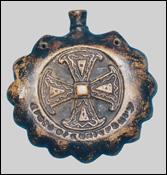
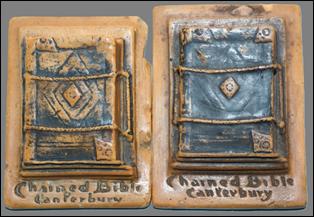
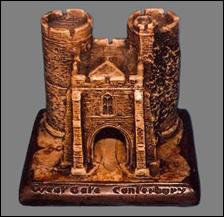
The souvenirs for sale included such things as ‘Canterbury Pilgrim Bottles’ which are found with inscribed dates ranging from 1905 through to 1930 so we know that they were making these for at least 25 years, as well as models of the well-known ‘West Gate Canterbury’, a ‘Coronation Chair’ (sculpted by W. Millar** in 1900), also the ‘Chained Bible’, ‘St. Augustine’s Skull’, a model of the Dane John, and many other items.
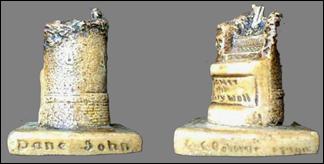
It was always assumed that Arthur Osborne designed and made these items and the sisters merely retailed them in their shop. But research seems to indicate that this is not quite correct and that we are doing a disservice to the talents of Elizabeth and Clara, and perhaps even getting the sequence of events slightly wrong.
In the census for Canterbury in 1901 the sisters, Clara then age 37 and Elizabeth age 44, gave their occupation as modellers of Plastic Sketches, and at this time Arthur was still living in East Street, Faversham and was manufacturing Plastic Sketches.
It seems very likely that in order to support themselves, E and C were actually modelling and manufacturing Ivorex-type products prior to Arthur starting up his business, maybe even before he had returned to England. If this was the case, he may well have gotten inspiration from them in his startup.
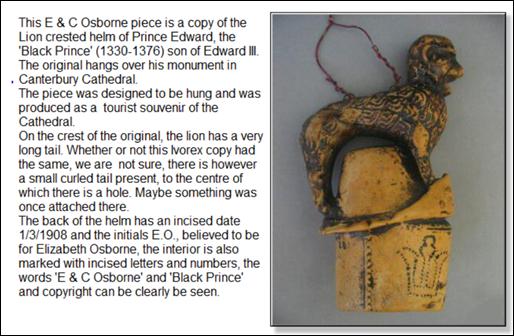
At least one piece dated 1908 (the ‘Helm of Prince Edward’) bears the initials E.O. for Elizabeth Osborne and was probably sculpted by her.
It is certainly known that Arthur avoided competing with his sisters right up to his death by not making plaques of Canterbury Cathedral that would have taken business away from them.
The large Osborne plaque that does exist of Canterbury Cathedral was made after both Arthur and his sisters had passed away. The small Canterbury Cathedral plaque was made in 1930 when the sisters were probably no longer in business. A smaller version of the E and C model of West Gate Canterbury was also made at a later date by the B. Osborne Company.
So far, ..this idea is only theory as all the dated E and C Osborne pieces show dates that are post 1900.
We can only wait and see what turns up.
** Note: W. Millar also sculpted the plaque ‘Ye Durham Knocker’ attributed elsewhere in site to Osborne.
Who W. Millar was is not known.