Ivorex History
The History of Ivorex
Researched and written by John Smith
Arthur Osborne was born Arthur Monk, in England on August the 13th 1855 in a house on Ospringe Road, Faversham, Kent, and would be the eldest of a large family typical of the times, with six sisters and two brothers, unfortunately, in common with the vast majority of people, his formative childhood years went unrecorded.
The only actual account of his childhood is one that he was to speak of in old age, and that was of his interest in carving birds and animals with his pen knife, from chunks of the local Kent chalk, something many have done over the years, but few with the ability to develop this idle carving into accomplished sculpting.
He was the son of a Faversham book seller / printer, who became Mayor of the town in 1862 and again in 1863. He lived all of his childhood within Faversham, when the family moved to London in 1868, Arthur, having shown artistic talents in his early years attended South Kensington Art School, which at the time, was considered to be one of the best in the country for art subjects. To enter this school founded in 1837, the young scholar was required to pass a freehand drawing examination and then enroll in a five-month intensive course.
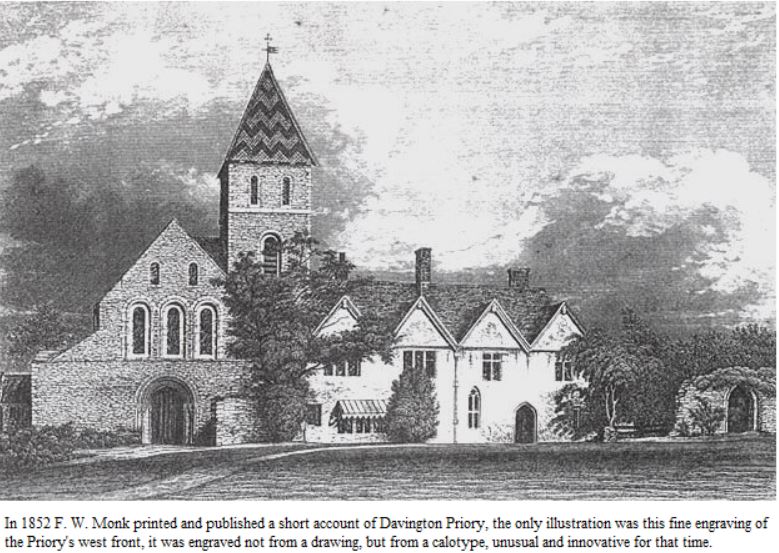
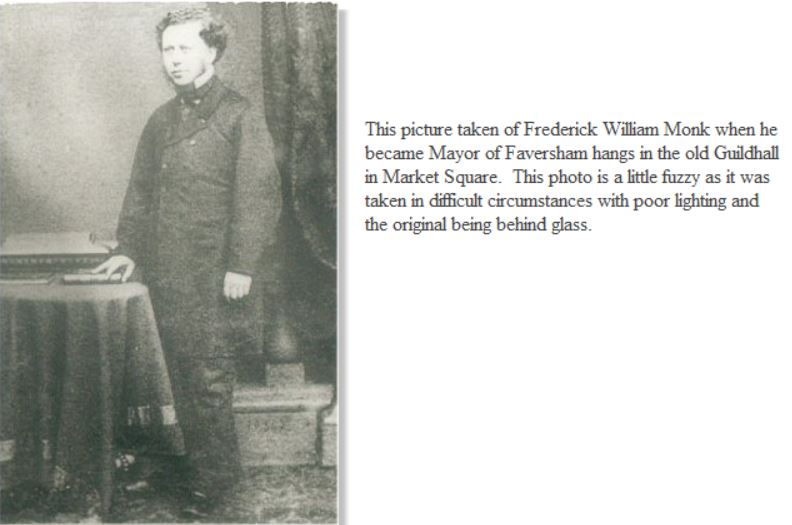
The studies included not only art but also literature and science, here Arthur had access to a museum of 27,000 objects and an art library of 24,000 paintings which would be a source of inspiration for his later work. Upon leaving the school he became apprenticed to a Stone Mason and worked on such buildings as the Gravesend Municipal Town Hall and the entrance to the deaf and dumb school at Margate as well as several Cathedrals, although throughout this time he was not entirely happy as he did not like using the sharp tools involved in this work.
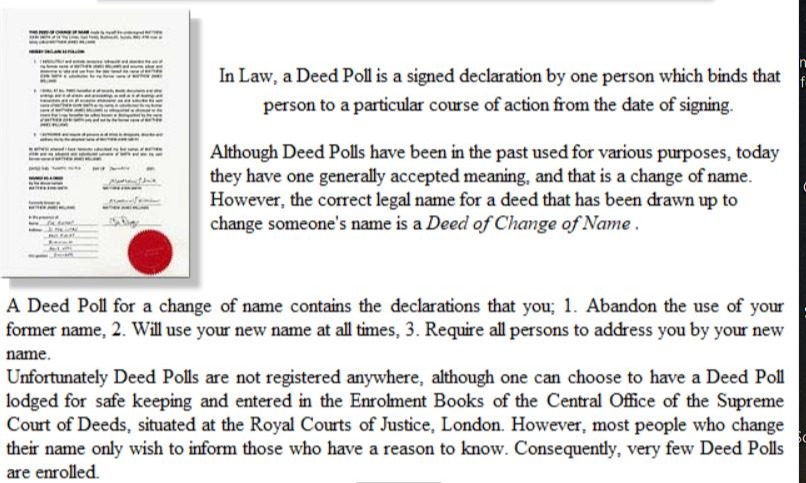
At some time in 1874 the family name was changed from Monk to Osborne, possibly by Deed Poll, and at some time around 1875, Arthur Osborne, as he would now be known, emigrated with the rest of his family, to Quebec Canada and then on to Boston in the United States of America.
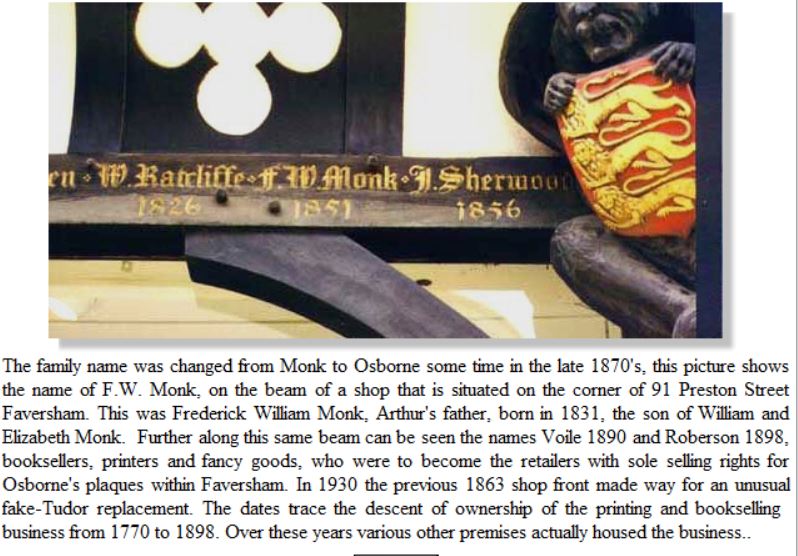
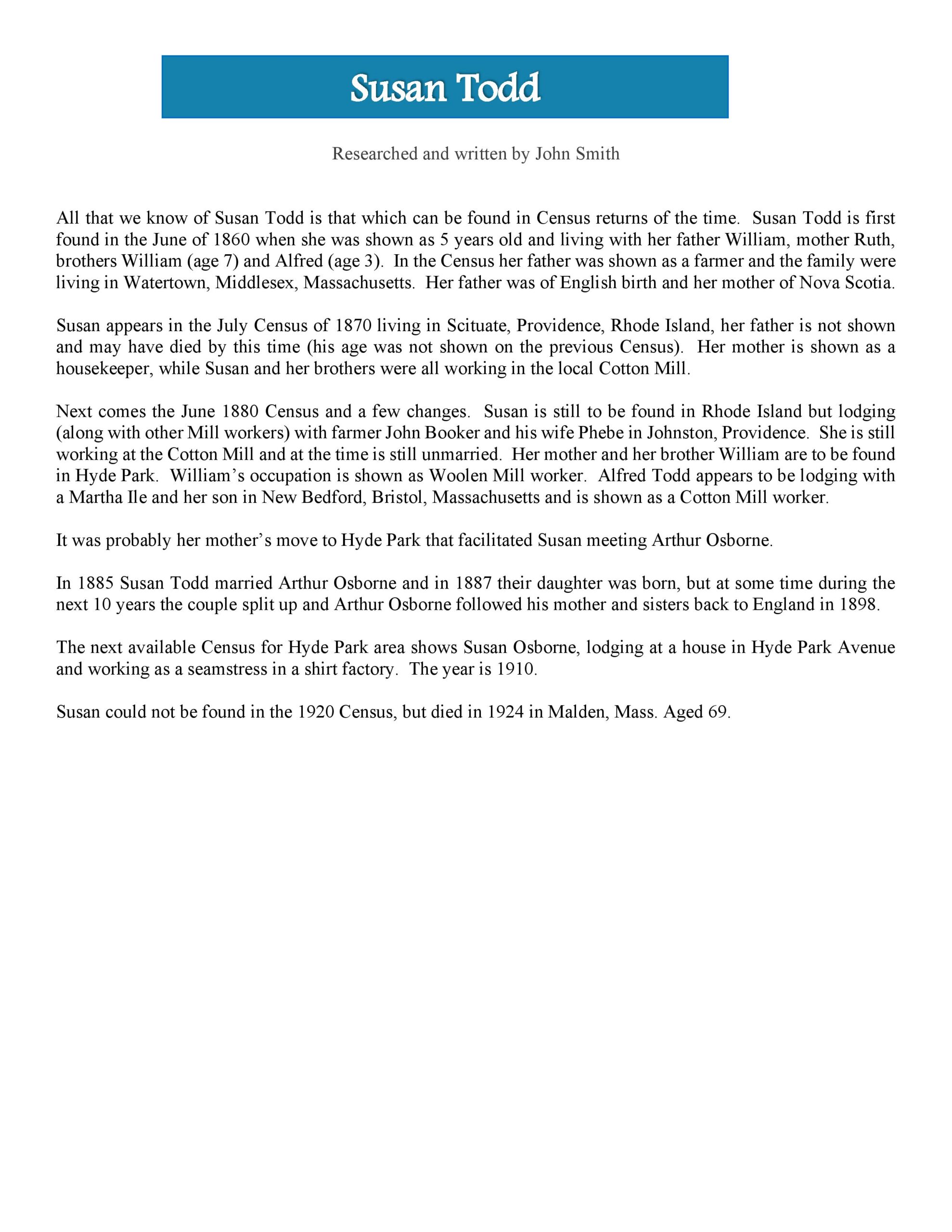
The Osborne family settled in Hyde Park which at that time was a separate town just under seven miles south of Boston. Here they resided at 7 Riverside Square, right alongside the Neponset River and where he would meet Susan Todd, who lived just around the corner at 57 Arlington Street with her widowed Mother and two brothers.
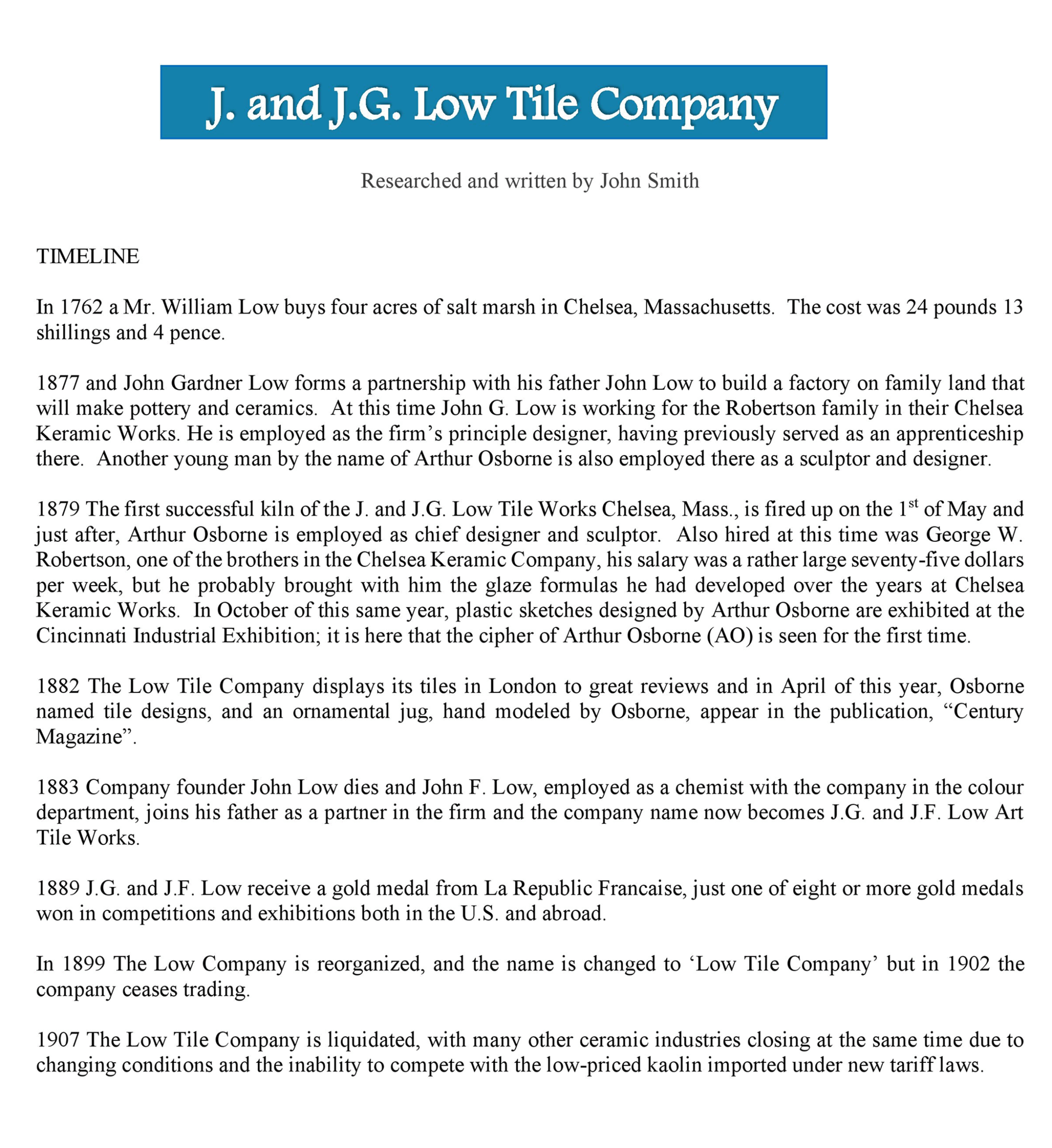
Arthur found a job in Boston, just a streetcar ride away from home, sculpting ornate headstones and monuments for a Company of Masons in Beverly Street, from here he moved on to the Company of Robertson and Sons at their Chelsea Keramic Works, founded in 1866, working as a designer. The Robertson family were also emigrants from England and had become established in Boston as makers of fine ceramic tiles and pottery They were well known for their exciting new glazes.
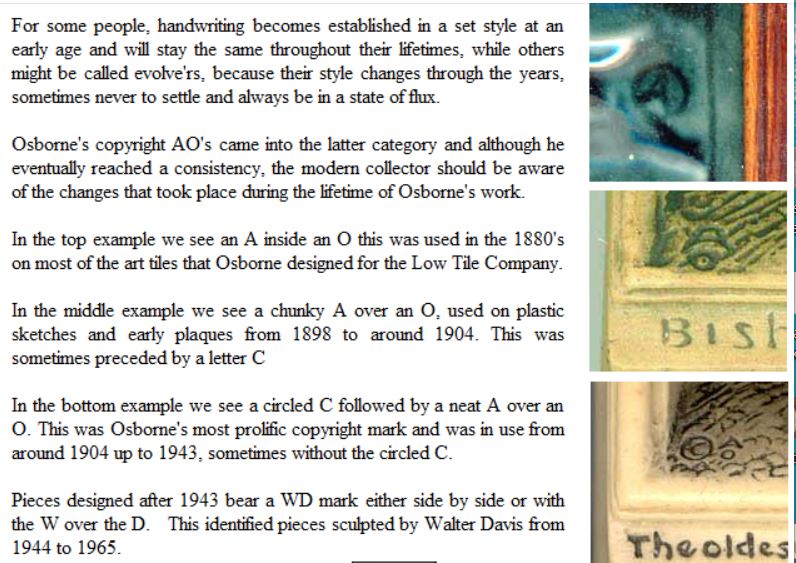
Here he met another Robertson employee, John Gardner Low, who in 1878 formed a new art tile company with his father John Low at Broadway and Stockton Street. In 1879 Arthur Osborne moved to new employment at the Low factory. At the J. and J.G. Low Art Tile Works in Chelsea MA. Arthur Osborne became the principle designer of their main product, low relief art tiles, and it was upon these tiles that the now familiar A.O cipher of Arthur Osborne first appeared.
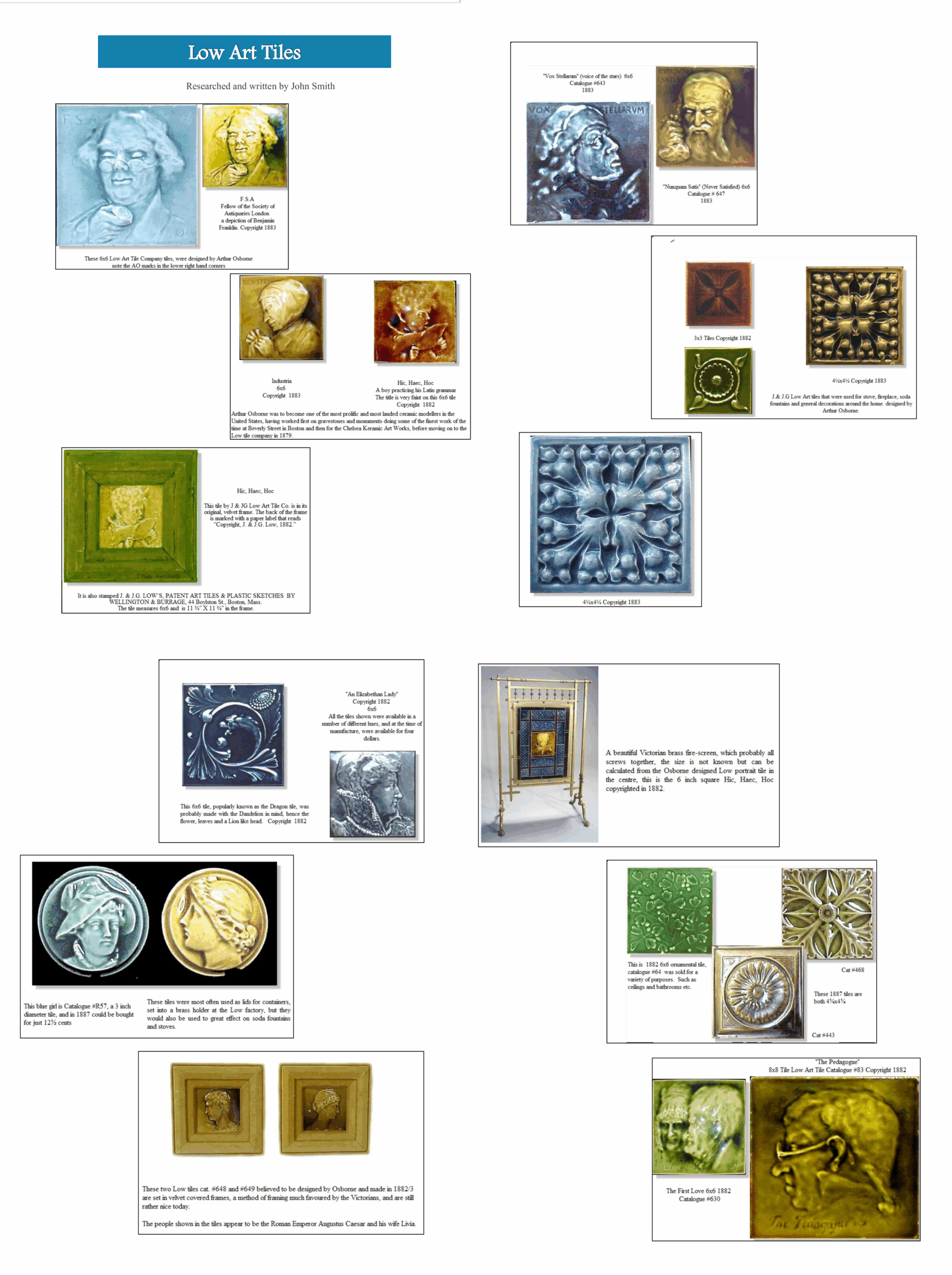
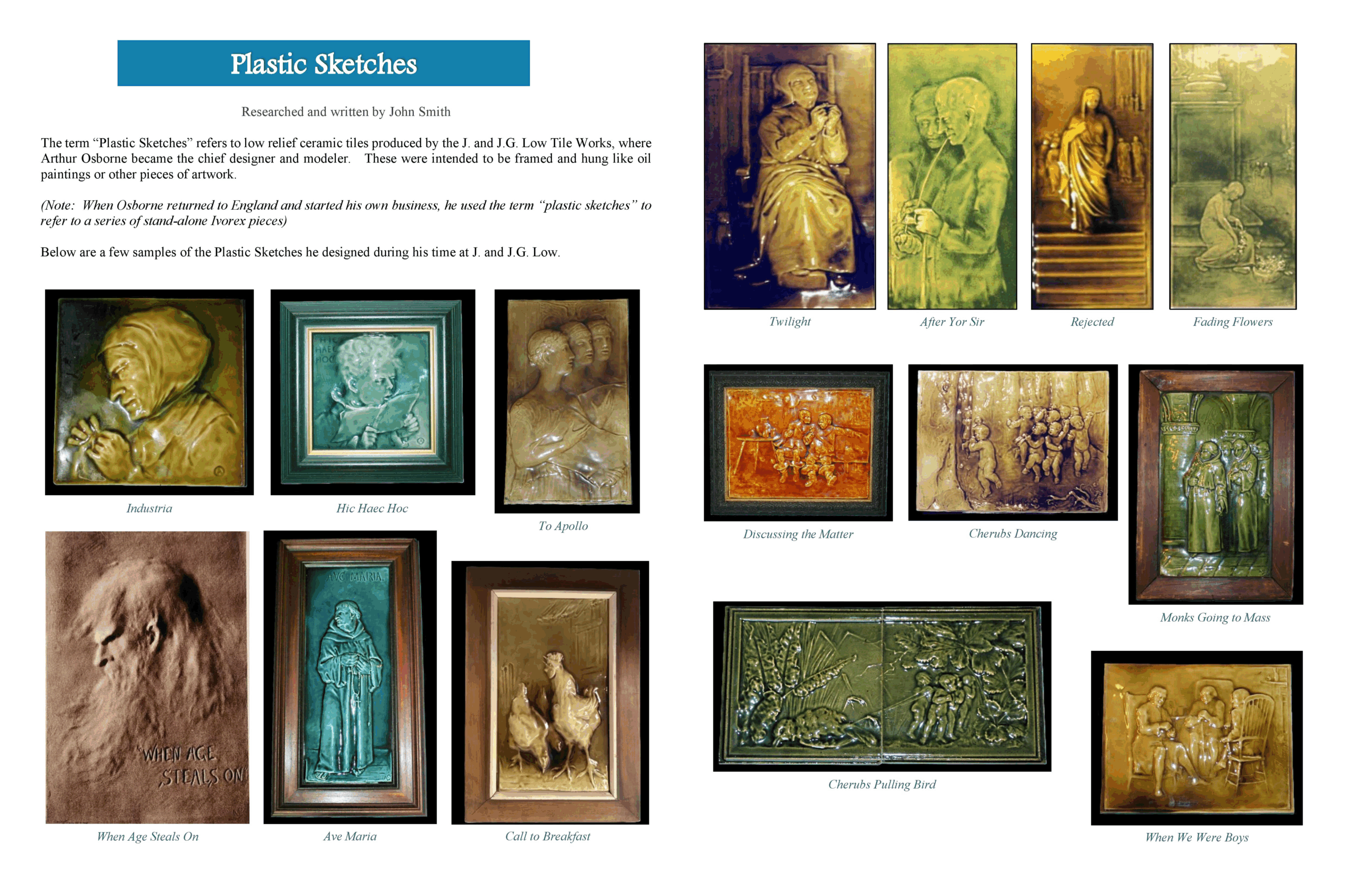
Along with the low relief tiles were a product known as Plastic Sketches, an art form in their own right, and a term that Arthur would use for a future project. These were rather like a large tile but instead of just a pattern they depicted artistic scenes and were actually framed and sold as pieces of art.
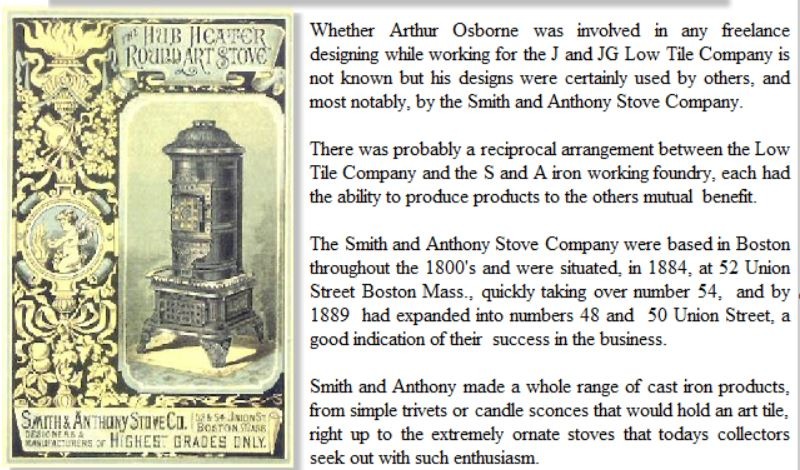
Osborne’s work also found its way into soda fountains and stoves. One of the stove companies that benefited from his talents was the Smith and Anthony stove company of Boston.
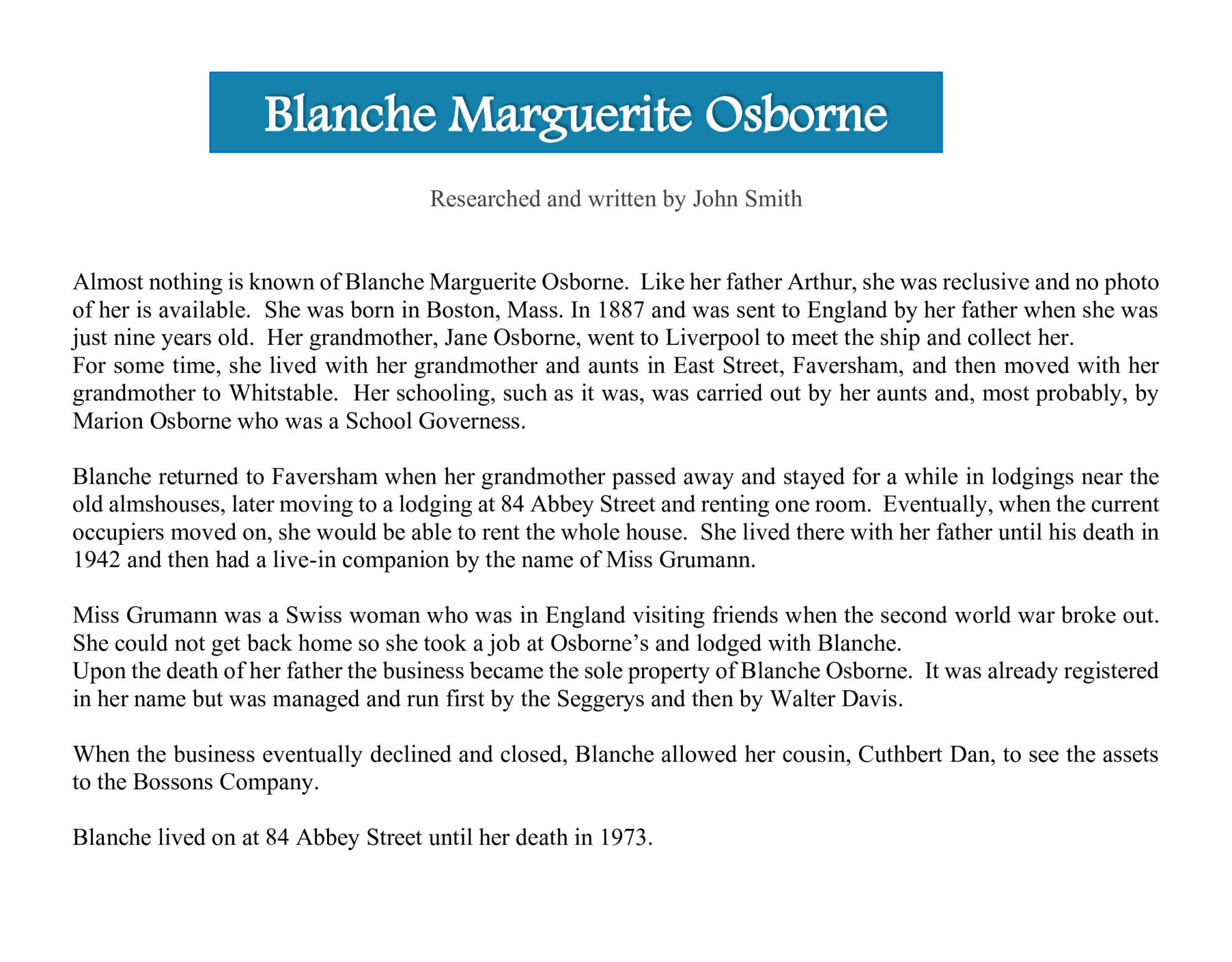
In 1885, on April the 25th, Arthur Osborne, who was now 29 years old, married 28-year-old Susan Todd, of English-Nova Scotian parentage, in Hyde Park Boston, Mass., and two years later in 1887, on October the 27th, a daughter, Blanche Marguerite was born.
Arthur Osborne applied for U.S Citizenship in Boston in the year 1890, and had made his final declaration in 1894, becoming a U.S. Citizen on the 22nd of September 1894. However, in 1898 he had left all this behind, sold up his Hyde Park property in 1897, and returned to England and his place of birth, Faversham in Kent. What prompted the return to England is unknown, Arthur Osborne had obviously been in a good position with the J and J.G Low tile company, and the company itself was doing well, moving from strength to strength, with their quality products in high demand.

It may well have been a family decision, but how many of the Osborne family actually returned to England is uncertain, his mother and sisters had returned several years before Arthur, as, in the 1891 census for Faversham we find that three of his sisters, Elizabeth, Clara, and Gertrude were staying with their Uncle and Aunt, Isaac and Sarah Dan, at their home in Preston Street, Faversham.
It appears that Arthur was one of the last members of the Osborne family to return from America but return he did. He had already sent his daughter Blanche home ahead of him when she was just nine years old, and she was met by Arthur’s Mother in Liverpool.
Susan remained behind in Boston, she never did go to England and died at the age of 68 in Malden, Massachusetts on November the 2nd 1925, Arthur was never to return to America.
Upon his return to England and Faversham, Osborne and his daughter took up temporary residence, along with his mother and two of his sisters in a house next door to the Institute, at 49 East Street.
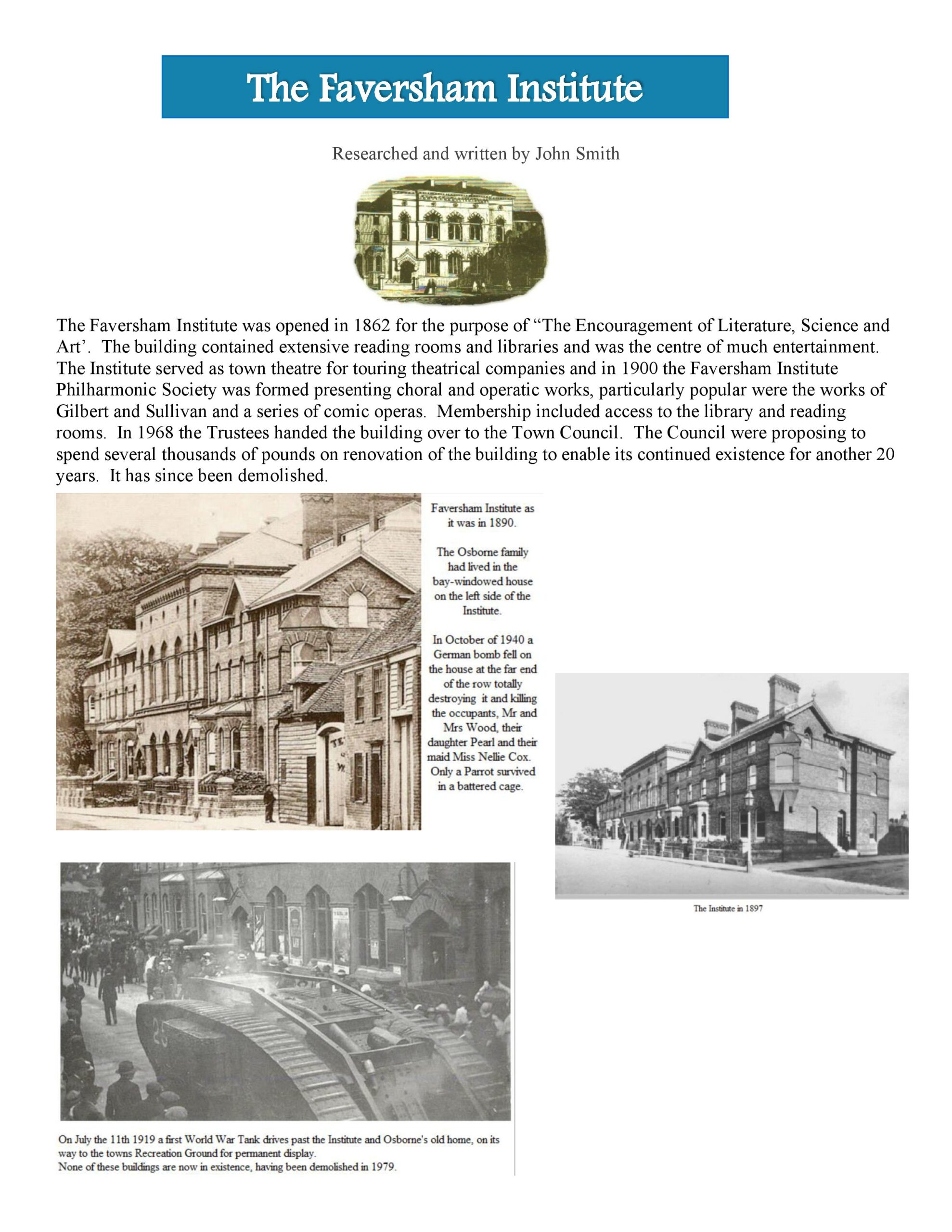
It is interesting to note that at this time he had relatives, Uncles and Aunts from his mother’s side of the family (Dan) living at both 44 and 51 East Street, so the occupancy of number 49 may well have been facilitated by family connections.
It was here that Osborne produced his first Ivorex pieces, plastic sketches, models and plaques, and it appears that his first retailers were two of his sisters who kept a shop at 8 Alexandra Terrace in nearby Canterbury, these are the E and C Osborne that we see on some named pieces such as the Pilgrim Bottles, created by the obviously talented sisters Elizabeth and Clara, and which sold readily to the large numbers of tourists and modern day pilgrims to the City. Arthur Osborne had an agreement with his sisters not to produce Canterbury plaques himself as this could harm his sisters’ trade. The Osborne Canterbury Cathedral plaque that was eventually made was created by Arthur after both sisters had died and was actually produced only after Arthur’s own death, having been completed by W. Davis.
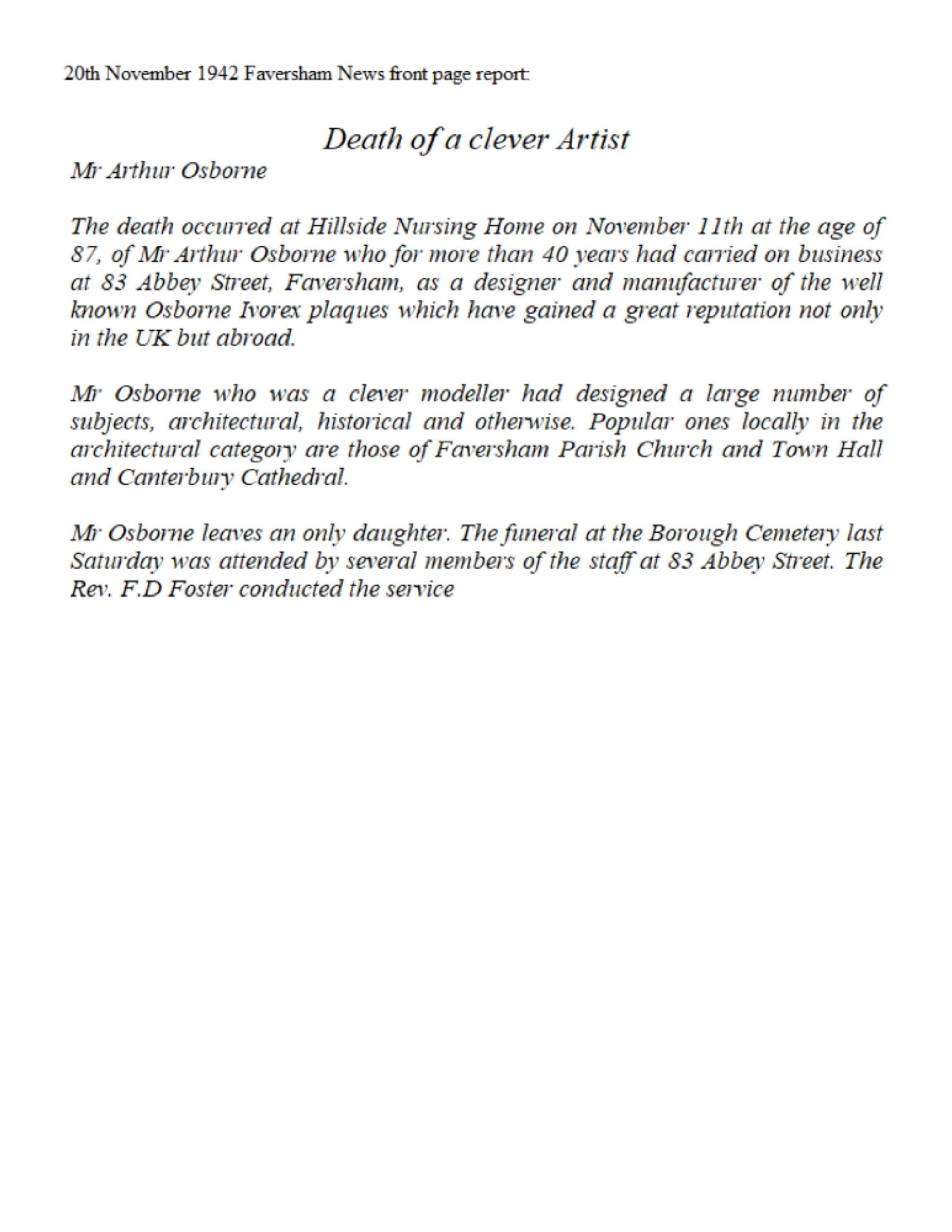
Arthur’s very first pieces were free standing Plastic Sketches, the name being derived from the term for clay when it can be carved and moulded into shape i.e. plastic, and the word sketch which simply referred to the scene depicted. These plastic sketches gave way, as early as 1901, to the more familiar, detailed “Ivorex” plaques, which, from time to time are often wrongly called wax plaques, with their consistent style of titles, which were to form the basis of a thriving Faversham industry, producing thousands of products for well over sixty years.
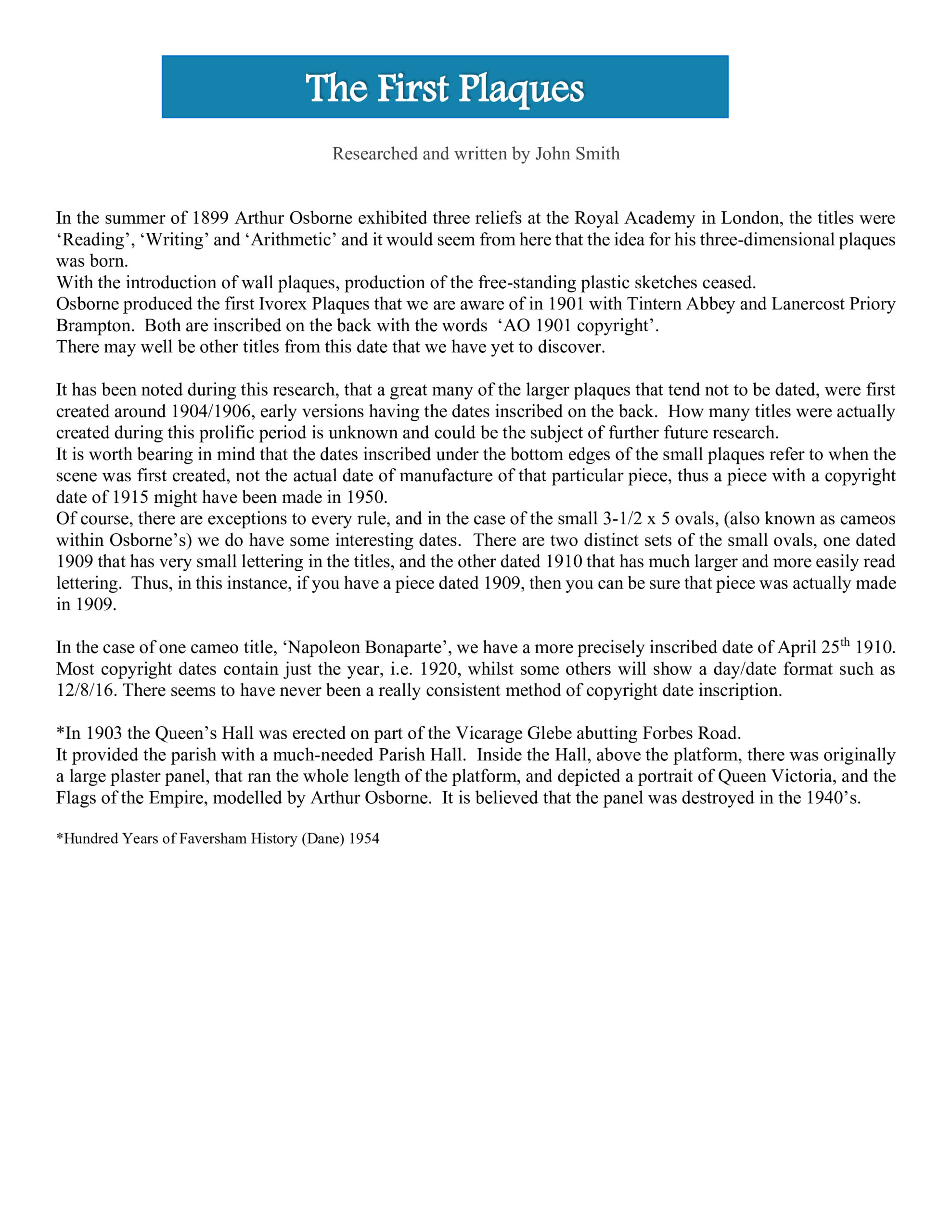
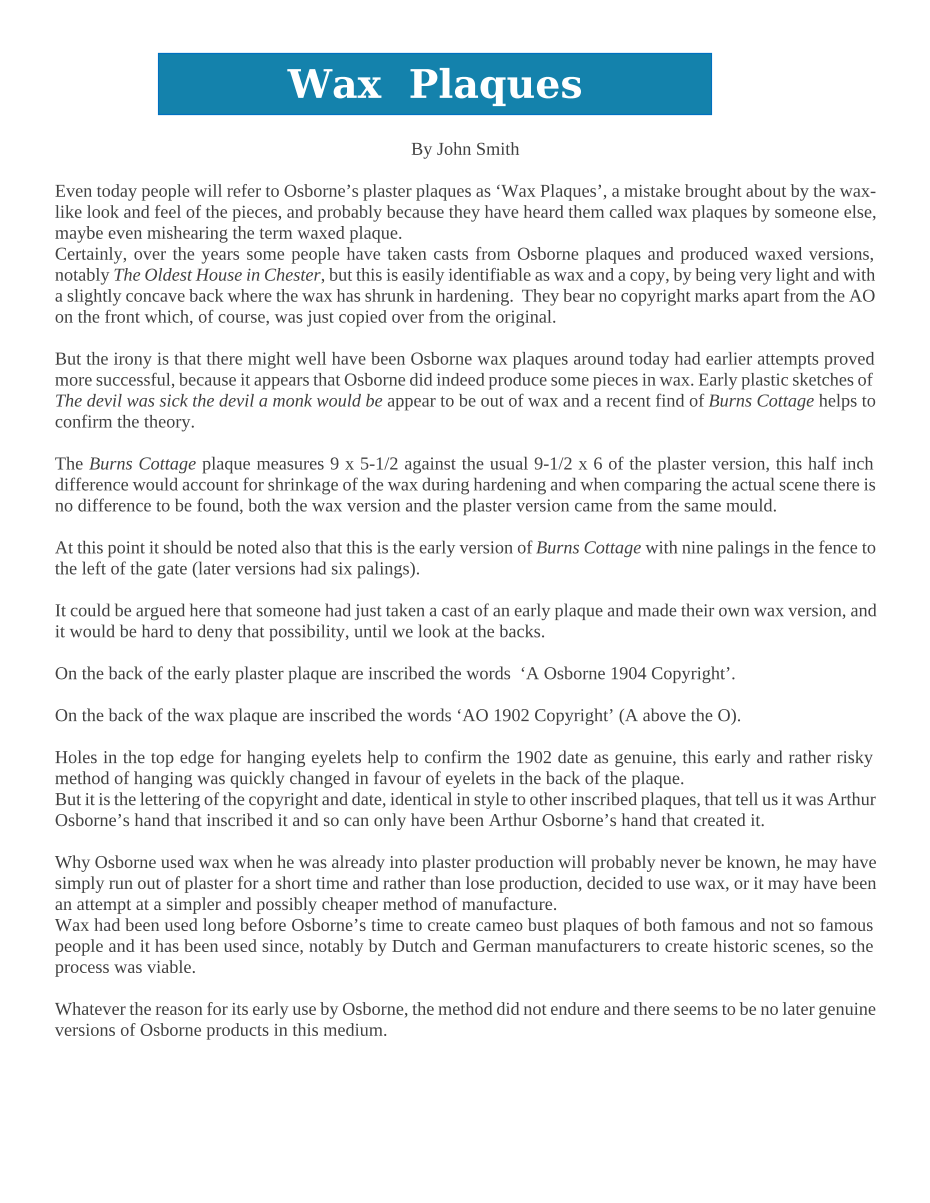
Admiration for Osborne has to be admitted at some stage, as like many businessmen, in his early days he had to be chief cook and bottle washer, he not only created the scenes on the plaques but he must have made and painted a fair number of them himself until molders and painters could be employed and trained, he must also have been his own buyer of bulk materials and his own salesman. At this early stage of the business, he had to actually create a market, and then fill it.
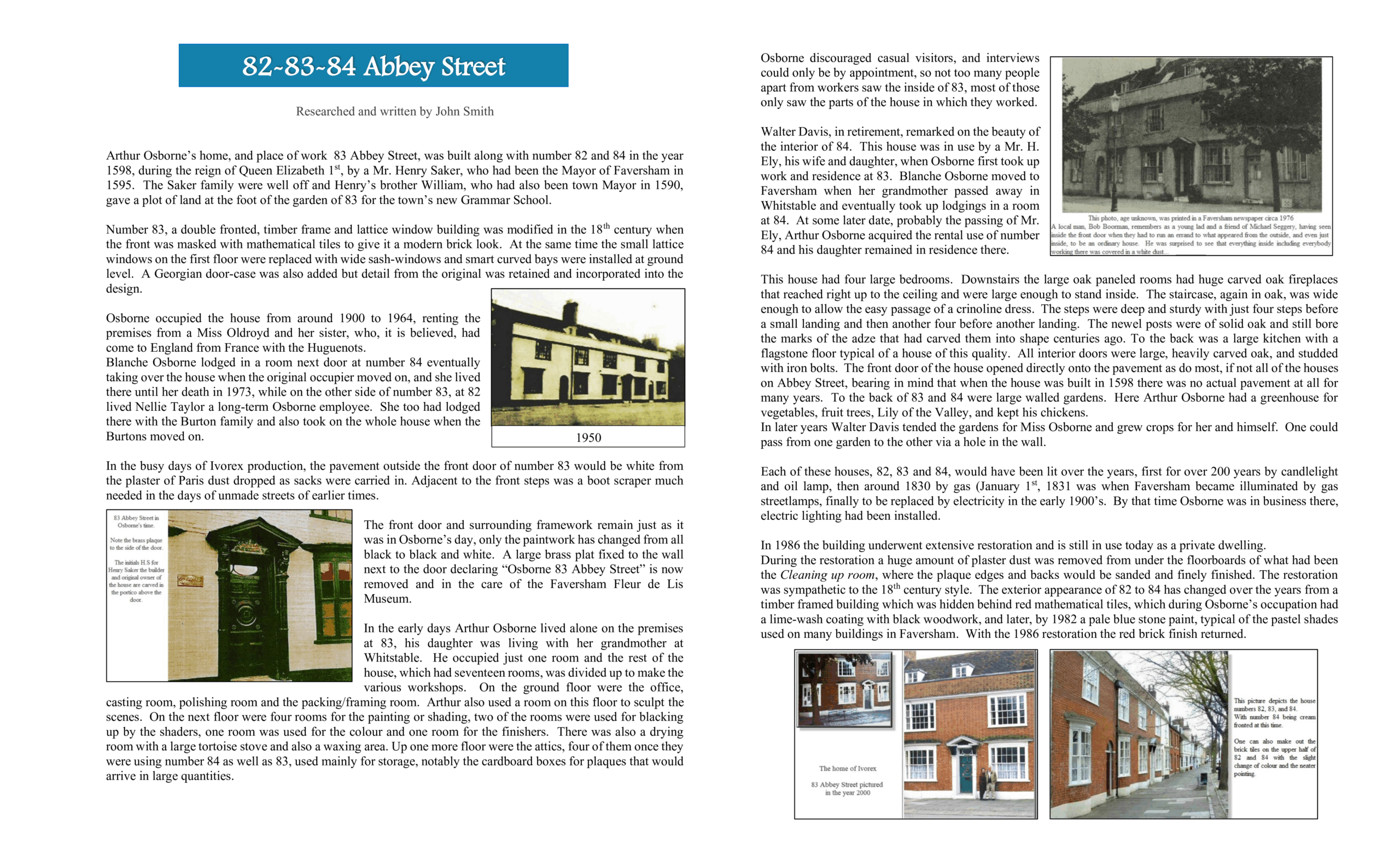
Around 1912, as the business steadily expanded and orders increased Osborne moved to larger premises at 83 Abbey Street, at first he only rented one large room as a living and working space, eventually his daughter would move into 84 and they would then use number 84 as a dwelling and 83 as the place of work. This was a large house built by the wealthy Faversham resident Henry Saker in 1598; a timber framed construction that has, since modernisation in recent years, been clad in brick tiles. This was to remain the firm’s factory until its closure in 1964, and it was on the 3rd of March 1931, that the company of B. Osborne was registered as a business operating at this address.
The telephone number was Faversham 60, and the telegraphic address was “BOCO” Faversham.
The “B” in B. Osborne refers to Blanche, but why the business was registered in her name is unknown, maybe a lesson learned from the bankruptcy of Arthur’s father many years before.
Having been born and bred during the reign of Queen Victoria, Arthur could not help but fall into the category that we now call the Victorians. Had the writer Charles Dickens ever met Mr. Osborne he would surely have described him just as picturesquely as his own creations of Mr. Pickwick or Mr. Micawber, because Mr. Osborne, in his own way, was just as much an impressive individual, he was a man of his own making and yet, at the same time, a product of the era, Victorian by birth and Victorian by nature, and of such a unique appearance, that had one passed him on the street, his image would surely have been remembered.
He was a stocky man, around five foot six tall with close cropped white hair that had no parting, this was complemented by a fine white moustache on a full and cheerful, yet at times, stern face.
His normal attire would compose of a comfortable brown woolen three-piece suit, consisting of a jacket, waistcoat and trousers, complete with a white shirt bearing a stiffly starched white collar around which would always be a bow tie, something of an unintentional trade mark. He would have worn a hat just as everyone did in those days, either a smart flat cap or maybe a bowler, but it is probably likely, that given his long exposure to American influences, his hat of choice would have been the ever more popular trilby. On his feet he wore black shoes, always immaculately polished and something of a status indicator, hobnailed boots were the order of the day for the working classes.
This would be his attire for general leisure wear, and his walk to the local barbers, one of the regular but few occasions when he would venture outside of his home. At work the shoes and trousers would be changed for another, older pair, coated by plaster dust, off would come the bow tie and stiff collar, and the shirt sleeves would be rolled right up revealing stocky arms.
The Osborne Ivorex price list catalogue states that Interviews could be by appointment only, which made Osborne seem reclusive and perhaps unapproachable, but this was not at all unreasonable, anyone would wish to be looking respectable when meeting clients.
Today it seems almost impossible that one could work in the same house as the boss for many years and never catch a glimpse of him, but in those Victorian times there were levels of hierarchy whether in the home or in the workplace, and no one thought to question the order of things. Arthur Osborne was always addressed as Mister Osborne by all those he came into contact with, even his most senior employees, and he, throughout his entire life, addressed them only by their surnames, this was just the way things were done in the Victorian era and beyond. Out of earshot, Mr. Osborne was known as the boss or the guv’nor.
Osborne created highly detailed master plaques in clay, and in later years, because of difficulties in needing to keep clay moist, Plasticine, using picture postcards from locations all over the world as his reference source. Some of these cards can still be found today and show the incredible attention to detail that Osborne achieved in his creations. Osborne’s salesmen would also take photographs of likely tourist attractions and would return with them to Arthur for a sample plaque to be made up, this would then be shown to retailers in that area to secure an order.
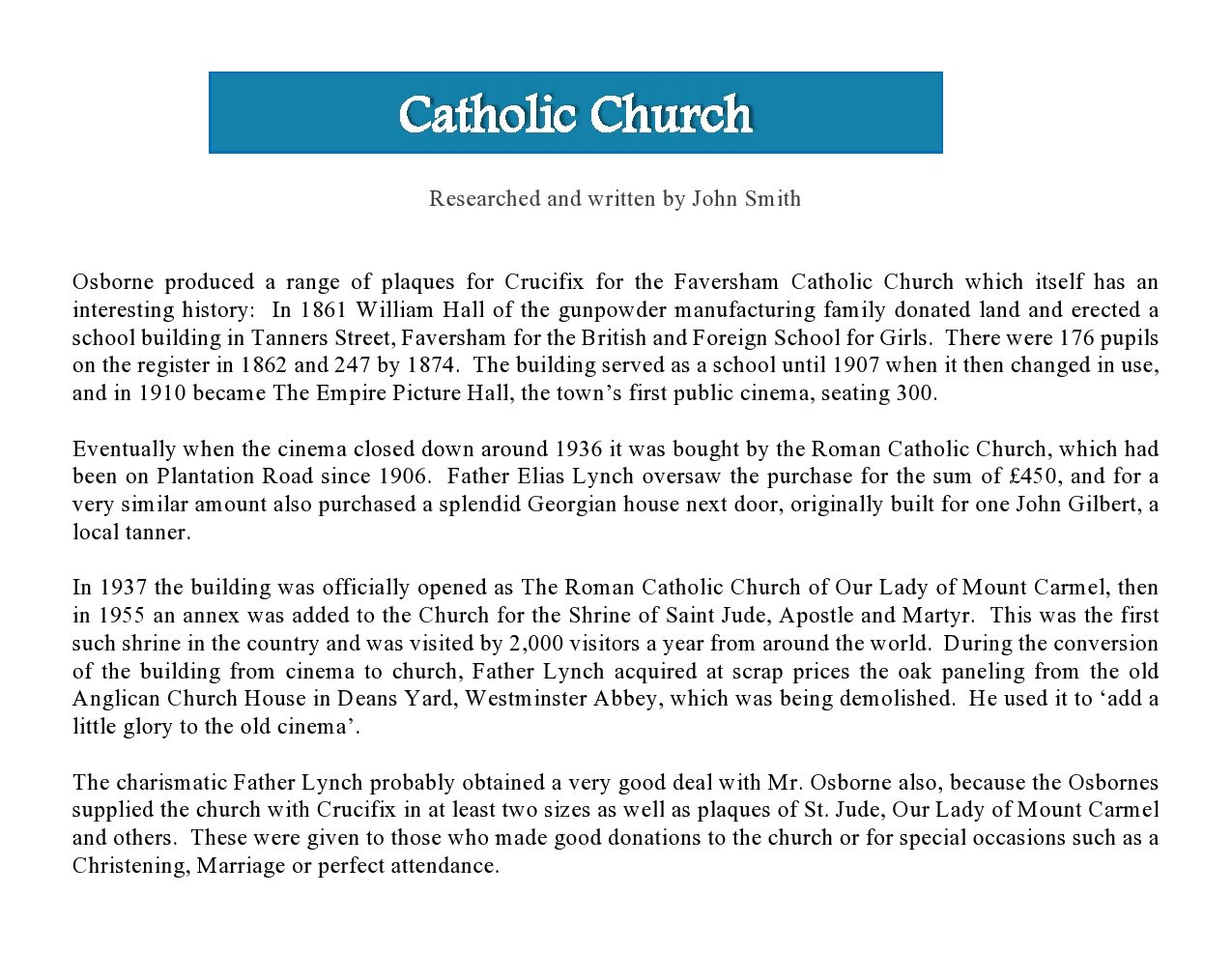
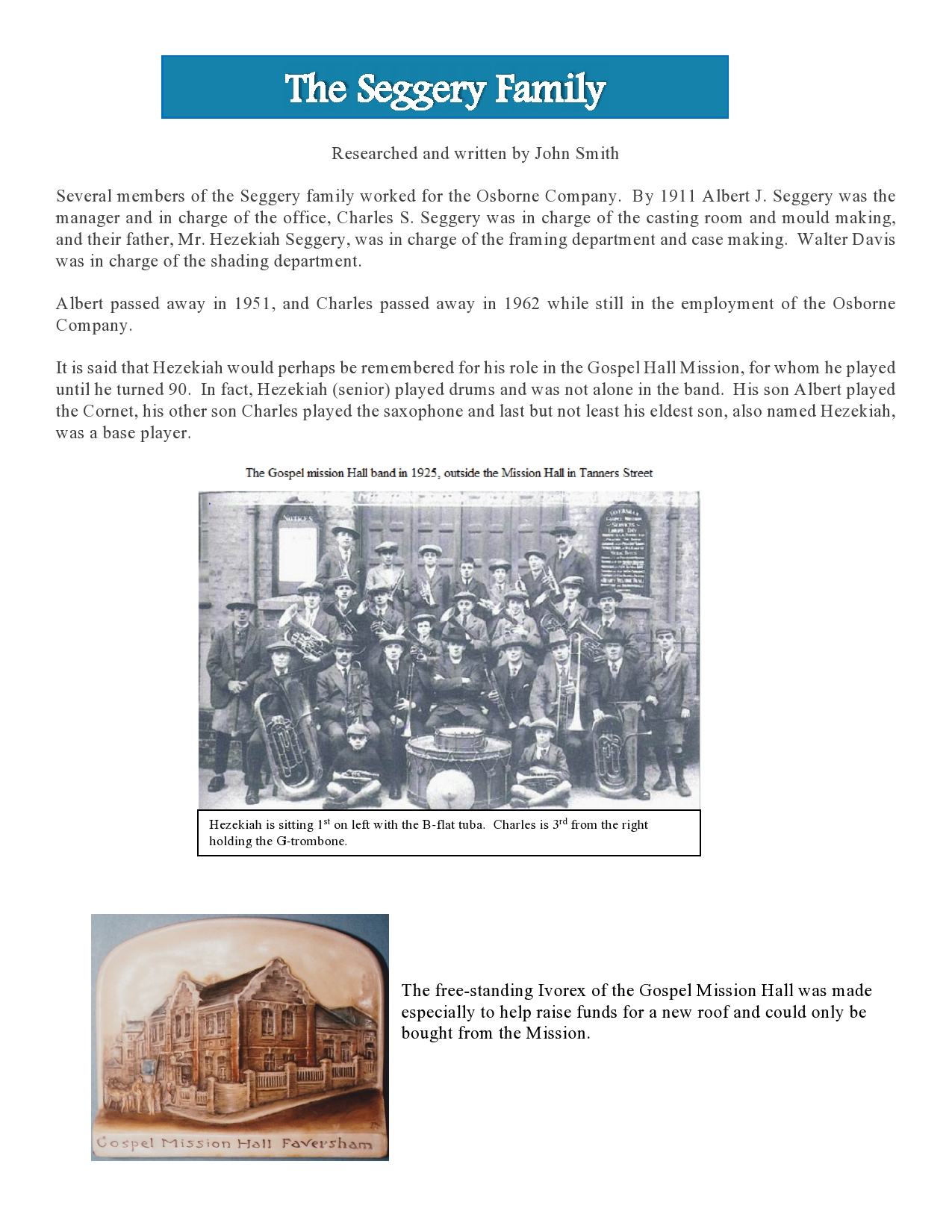
Other orders were made on commission, many for the Catholic Church, and there was also a special collection of scenes for a South African Society. One of the rarer pieces is “Gospel Mission Hall Faversham” this was a free-standing shelf piece, made solely for the Mission Hall in order to help fund a new roof, and was only available to those who attended the mission, it was never on sale to the public.
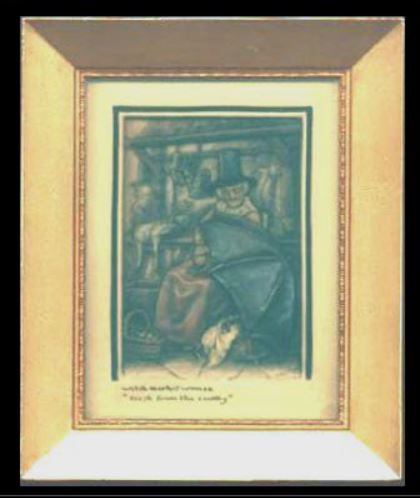
As well as being a master sculptor, Arthur Osborne was a keen businessman and customised his product to meet customer requirements. Plaques could be bought framed in a black or brown lacquered frame, with or without a fancy moulding, with or without a deep brown velvet slip and with or without glass. Some of the smaller plaques were also placed in a gold frame, glazed but without the velvet slip. The choice was the customers and prices for the variations were available on application.
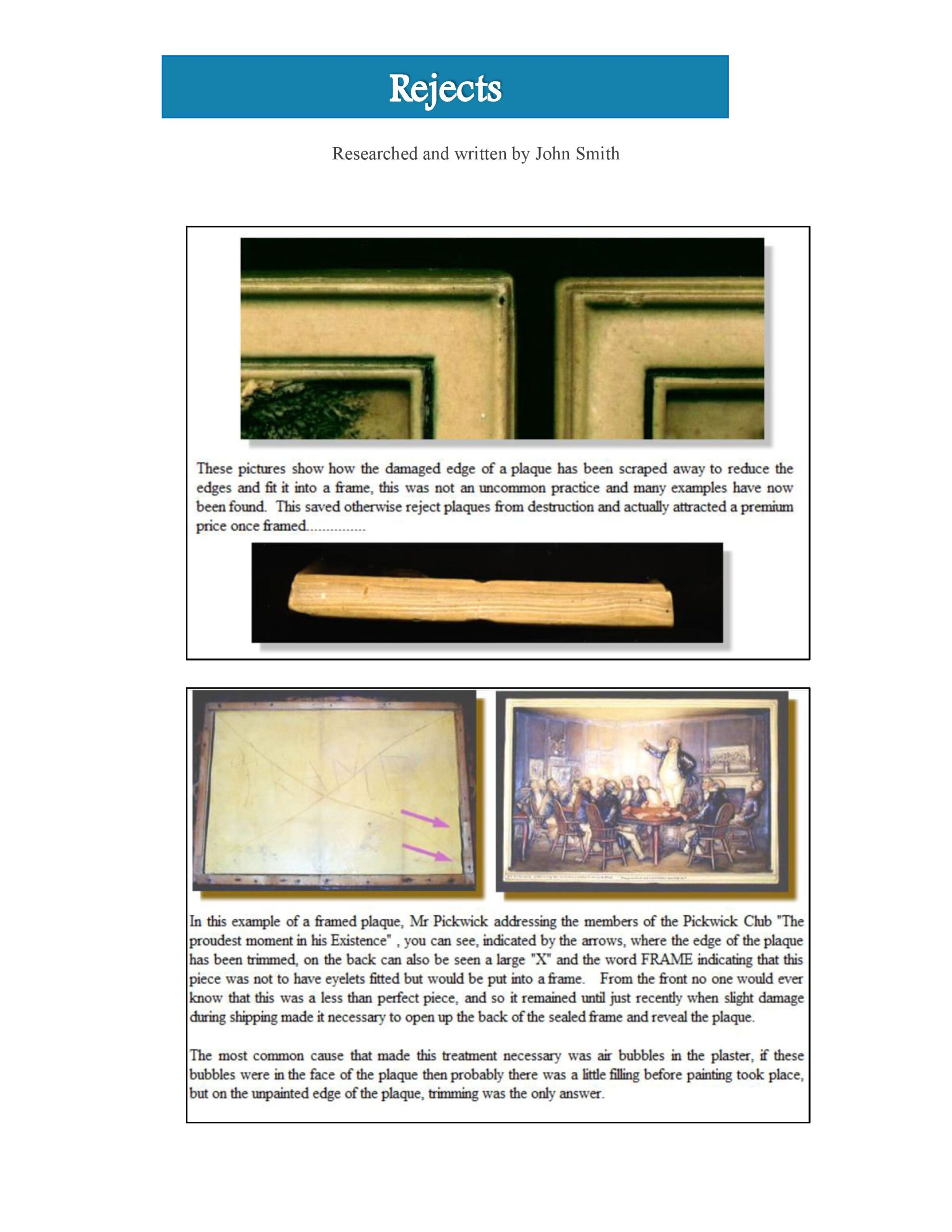
Research has amazingly shown us that Osborne used his frames to retail plaques that would otherwise have been reject, those that came out of the moulds with the edge less than perfect would be trimmed slightly with a file or rasp and then be placed within a frame where the edges would never be seen, thus a plaque that might have been scrap would be sold at a premium. Prices were based almost purely on size and whether framed or not.
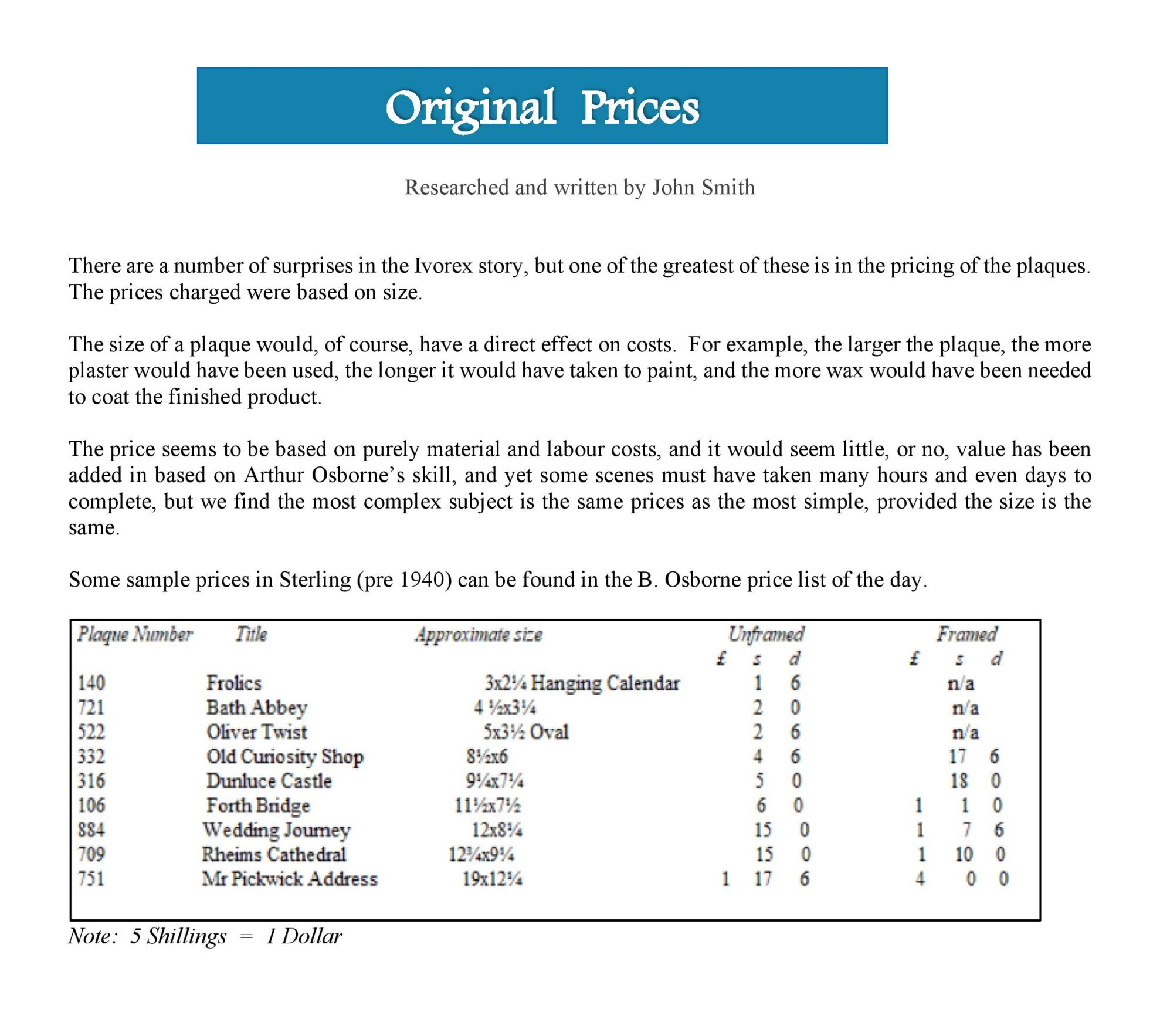
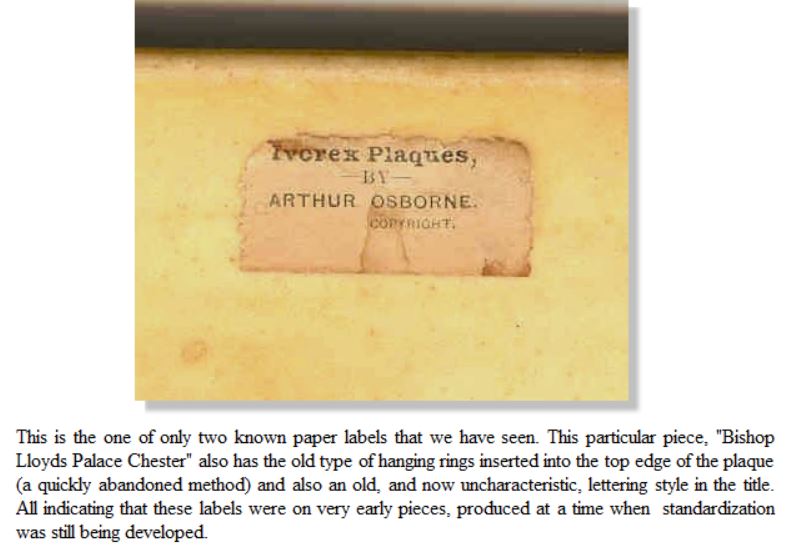
Osborne was also very alert to world markets and used poetic license in his choice of plaque titles in order to accommodate the country and markets in which he would be selling, thus Burns Cottage Interior would become Interior Habitant Cottage Old Quebec and an Old Cornish Cottage could become an Old Devon Cottage, many scenes were duplicated and marketed in this very clever way.
There are scene and title variations and even some spelling errors to be found among the many plaques that were produced. All of Osborne’s products were marked with a copyright, these marks were varied and numerous and often linked to retailers of Osborne wares in much the same way that modern retailers have their own name on branded goods.
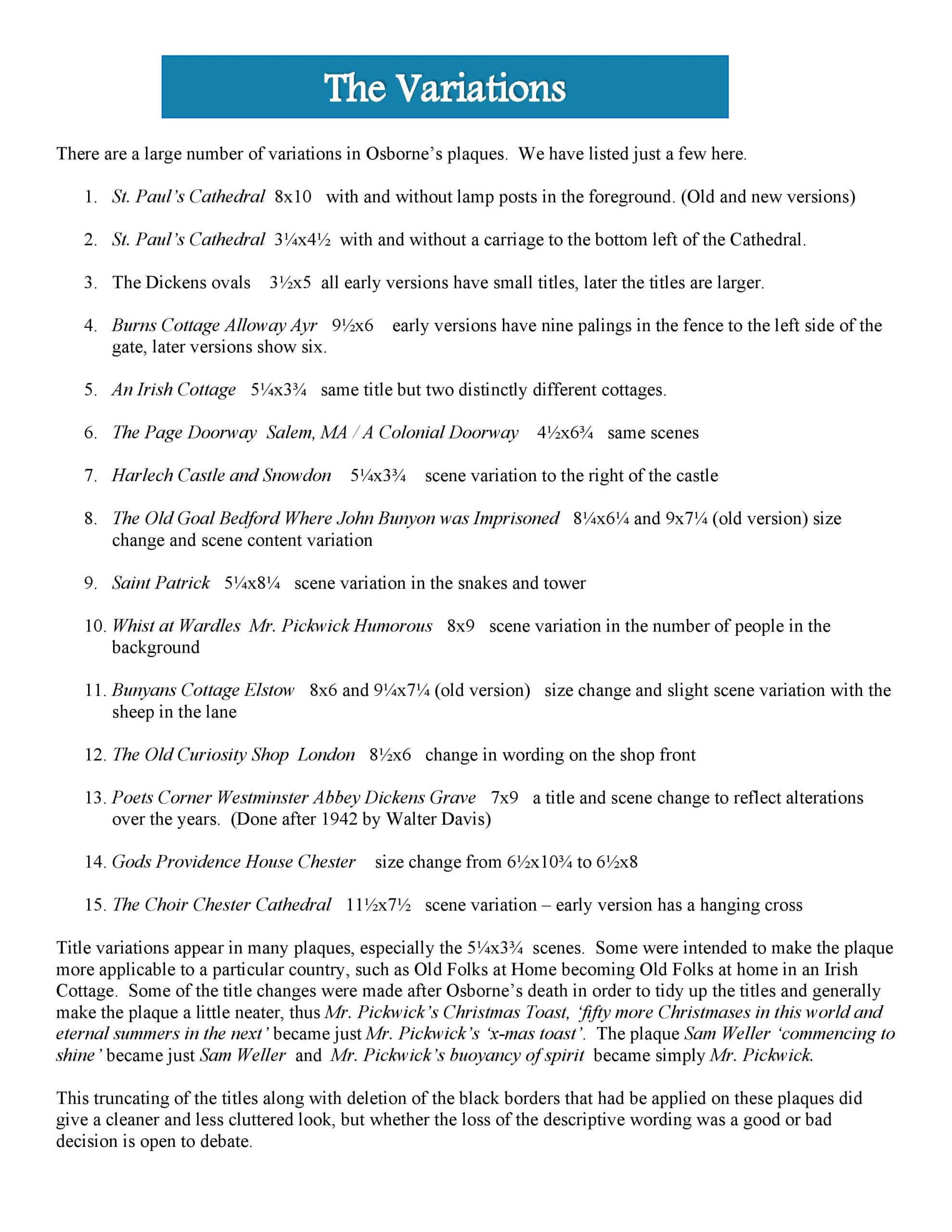
Good examples of this are Phillipson and Golder of Chester and T. Ltd Birmingham as well as many others.
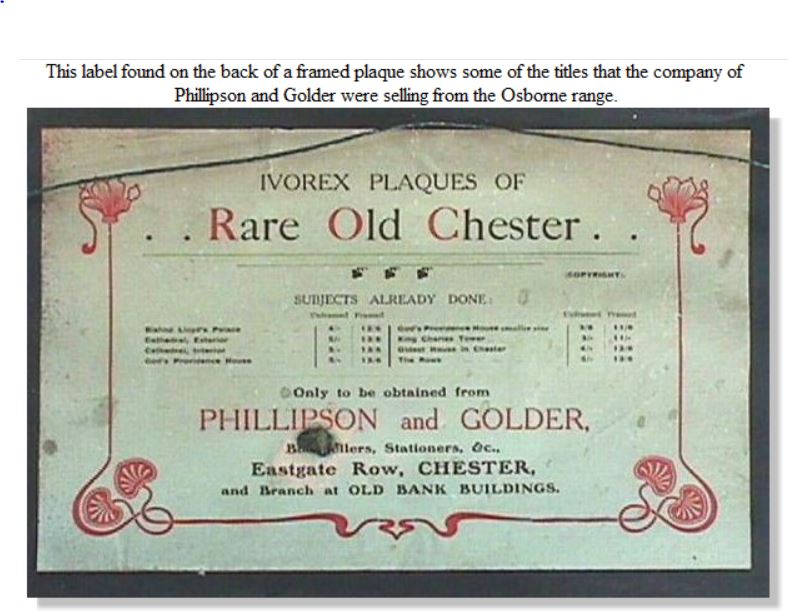
The earliest copyrights were incised on the back of plaques by hand, but these gave way circa 1928 to the more easily applied ink stamps that will be found in the bottom left hand corner, on the back of plaques, and on the base of free standing items. It would appear that a paper label was tried but soon abandoned, and we have just one example of such a paper label.
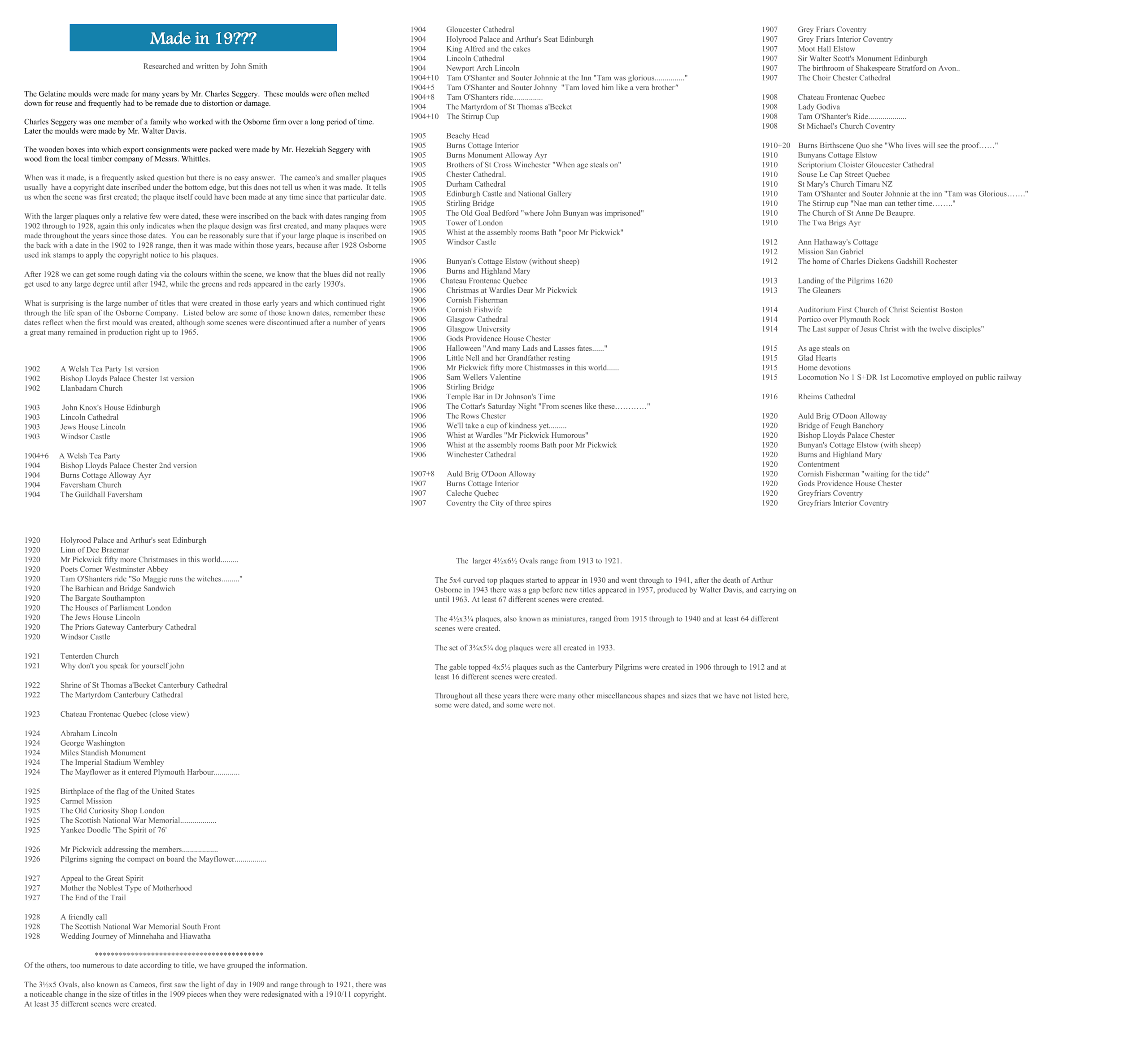
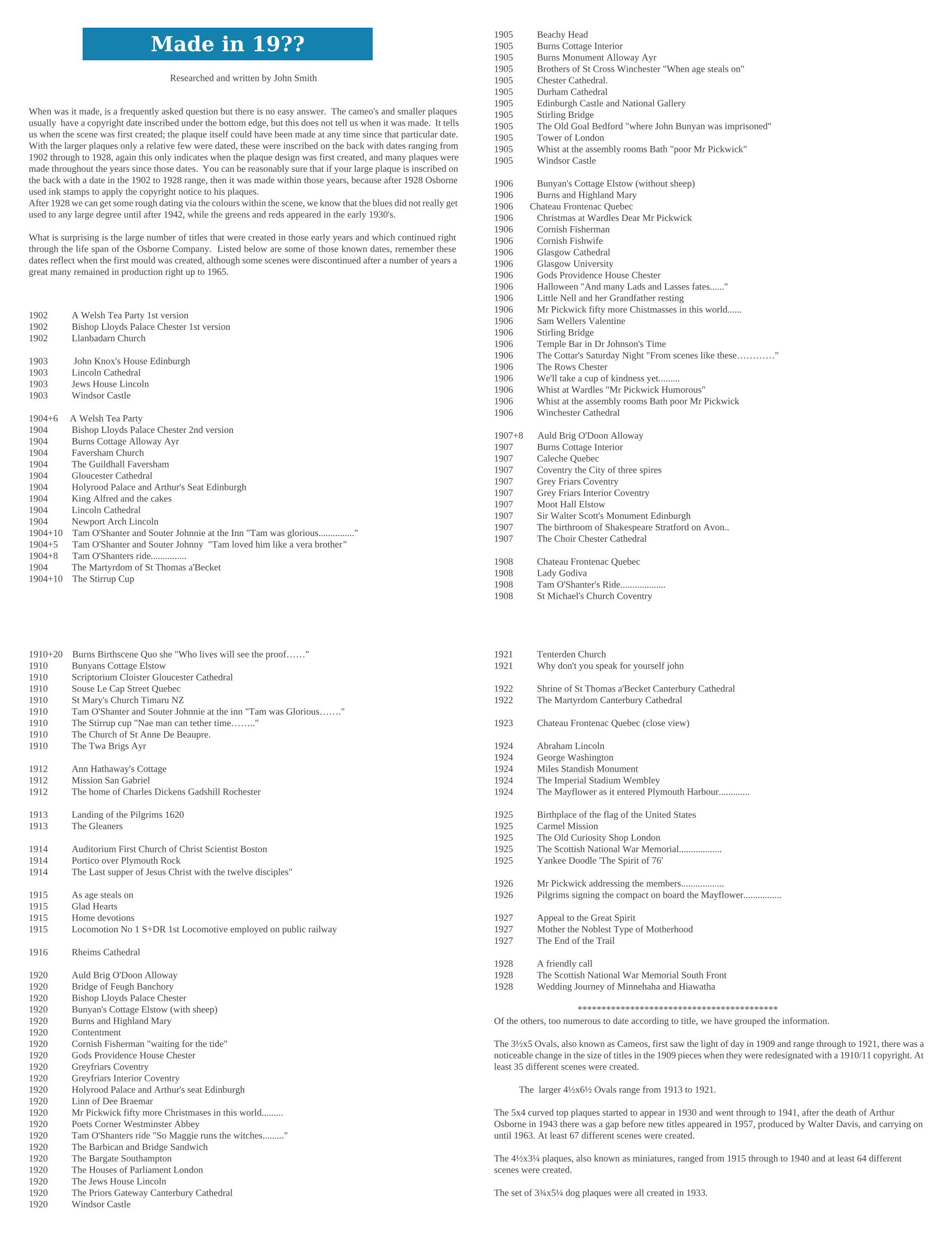
The copyright ink stamps never contained a date of manufacture, this was relatively un-important at the time, but of great interest to collectors now, fortunately many of the small plaques and some older (pre 1910) large examples do have dates incised, which can help date the large versions, but for the most part, this information is lost to today’s collectors.
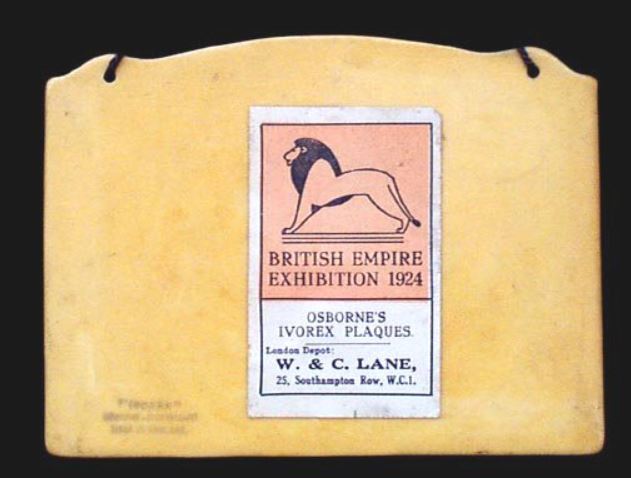
In almost an echo of the Low Tile exhibition, Osborne, in 1899, exhibited three of his own compositions at the Royal Academy in London, these were catalogued as Relief’s and were exhibit numbers 1962, 1963 and 1964, titled Writing, Reading, and Arithmetic. This was no mean achievement and an obvious recognition of the quality of his work. Sadly, the R.A have no record of what these works depicted. In 1924 Ivorex products were displayed and sold at the British Empire Exhibition held in Wembley London. Items that were sold at this venue bear a commemorative label on the reverse.
The business had grown steadily from 1898 as Ivorex plaques became ever more popular during the Edwardian era, employing 12 people in 1910, 20 by 1914 and in 1928/30, 50 people.
The First World War almost closed the business when the male members of staff joined the armed forces, but girls were employed to take up their places, this kept the company operational and just ticking over, but at the end of hostilities things were to greatly improve.
The plaques found a ready market in the United States of America and employee numbers rose to fifty to help meet demand. Arthur Osborne responded to this market by creating over 78 different scenes unique to the United States. Shipments to America became a fortnightly occurrence; with as many as a thousand at a time being shipped in cases that each held 180 items.
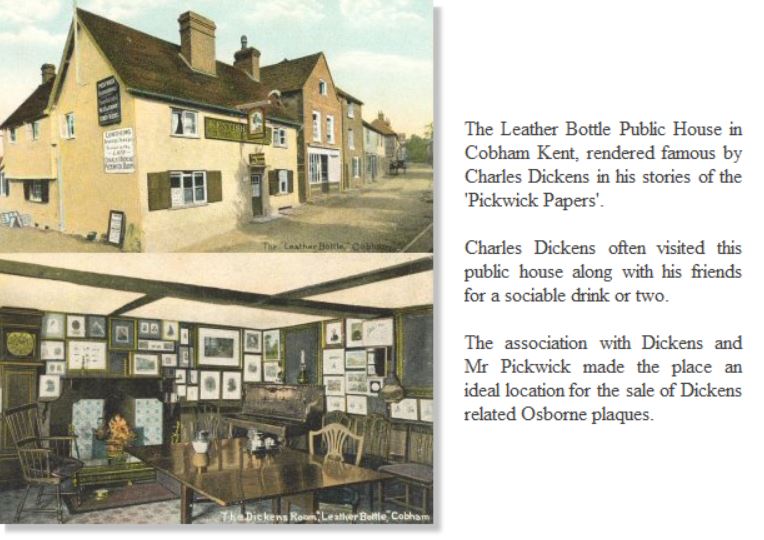
Salome Blackmore, who for a number of years ran an antique shop in Cobham, England, would order tea chests full of the 41 different Dickens subject plaques which she sold to tourists who had visited Cobham to see the Leather Bottle Public House, immortalised by Charles Dickens. Later the Irish market was to expand with five thousand plaques being dispatched annually for tourist souvenirs. Some existing plaques had their titles adjusted to accommodate the Irish market. Another good stockist of Osborne plaques was the original Old Curiosity Shop at 19 Portsmouth Road, London. Here shelves were stacked full of the Dickens cameo plaques and other larger scenes hung on the walls.
We do not have the actual production figures but from the known shipments, the annual production for shipment was 45,000 at its height, and the grand total produced over the company’s lifetime must have been truly enormous.
A significant item that is missing from our collection of Ivorex history are Arthur Osborne’s preliminary drawings. As a trained artist he would have made drawings prior to starting any work on a plaque, especially the more technically complicated pieces such as The Choir Chester Cathedral and we know that while working for the Low Art Tile Company he did just that, producing a sketch for each piece prior to making a clay mock-up.
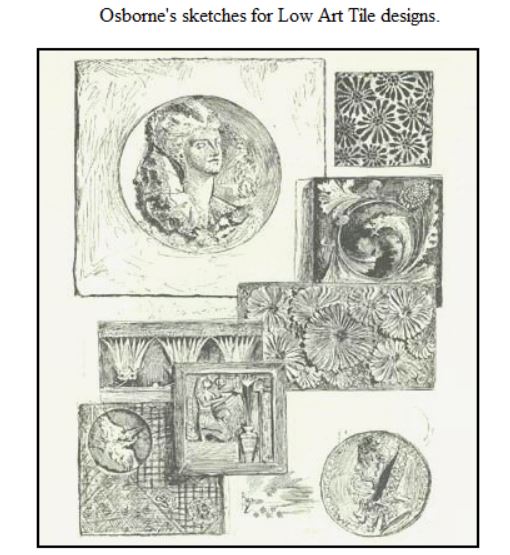
Obviously, the drawings would have had little importance for Osborne once they had served their purpose and there would have been no need to protect and store them. Most likely they were never seen by his employees and ended up on the fire.
What does remain, because they were made in their thousands, are some of the previously mentioned postcards that Osborne used in place of a drawing, these can be found amongst post-card dealers without too much difficulty. Good examples of these are Sous Le Cap Street Quebec and Caleche Quebec. These were divided into a grid so that placement on the plaque could be accurate.
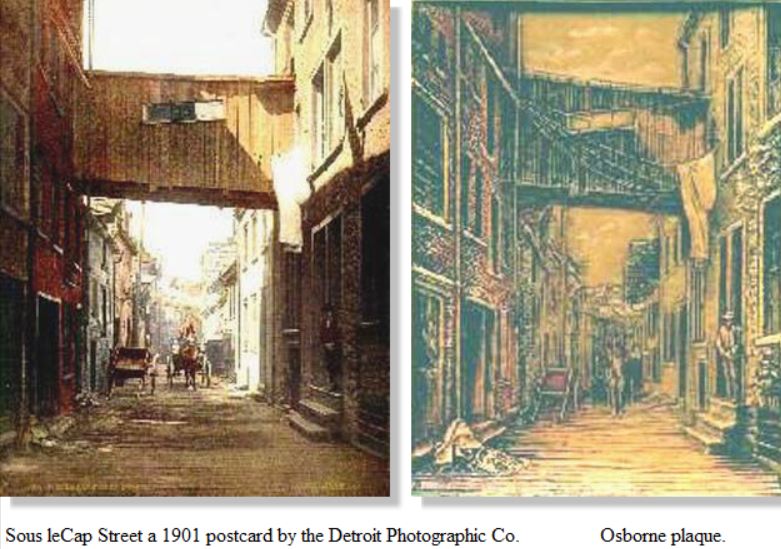
Of course, if one made a drawing, then the drawing could be made to the scale needed for the plaque, but this is not the case with postcards, and they have to be scaled up to the plaque dimensions required. The same is true of different sized plaques of the same scene.
A good example is The Angelus, with three different sizes and shape of plaques, another is that of Mr. Pickwick addressing the members……., in two very different sizes.
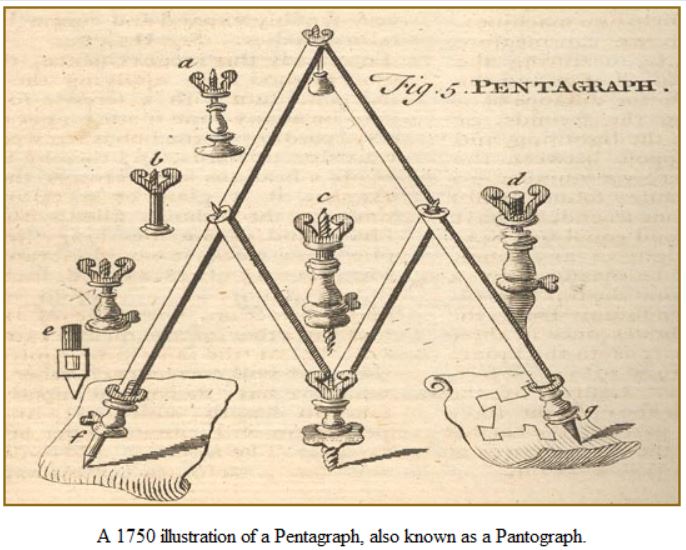
So how did Arthur Osborne achieve this, he had no photocopy machine or computer that could enlarge or decrease a scene from one size to another, it had to be done by hand and eye. There can be no doubt that he was very skilled in the art of sculpting but he must have used a tool that had long been available to artists and which he must surely have experienced at Kensington Art College, and that tool is the Pentagraph, a device for scaling a drawing up or down in size to user definable degrees. It is possible, though not proven, that Osborne may have transferred, via the Pantagraph, scenes from postcards directly onto a slab of clay, simply by placing a scribe in place of a pencil. Once inscribed in this way he could then proceed to modelling the relief.
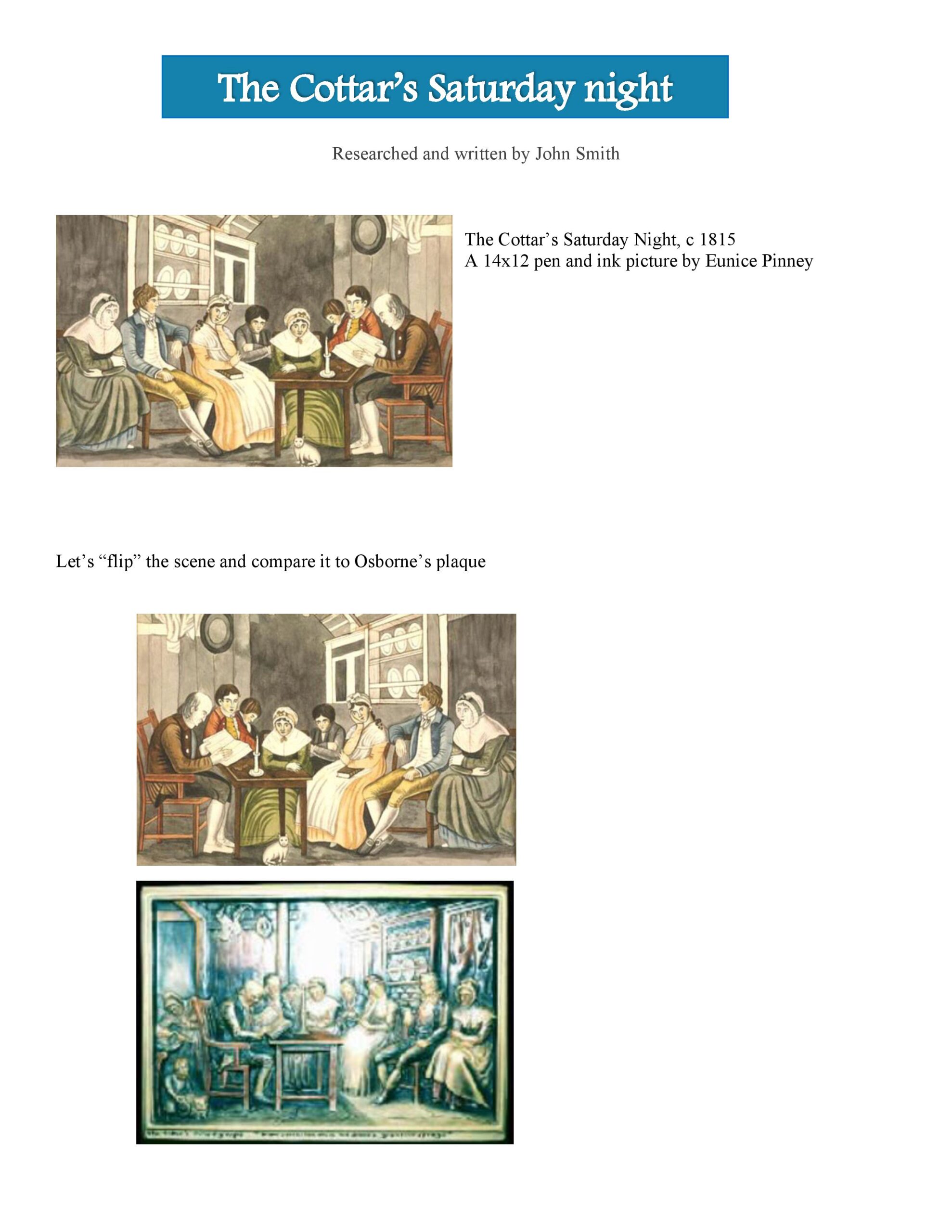
For other scenes such as The Cottar’s Saturday night it was a case of borrowing from other artists and adapting. In most cases actually improving.
In the 1930’s, at a customer’s request, Osborne produced a free standing figure of a Monk, having taken a mould from a German figurine, and we can’t help but wonder if this was not some bit of the devil in Osborne showing through, because few people in Faversham at this time would have known that Mr Osborne was once Arthur Monk, the son of Frederick William Monk a well-known figure in the town prior to 1878. Even earlier in 1900 Osborne made the Plastic Sketches The Devil was sick, the Devil a Monk would be / The Devil was well the Devil a Monk was he, these titles might well have been used as a cryptic message, a play on words, signaling the return of the Monk family to Faversham.
Throughout the existence of the Osborne Company various brochures were made that tended to reflect the company’s fortunes, starting off modestly it became quite a nice booklet with titles listed showing sizes and prices both framed and unframed, and also a good selection of pictures of the plaques, at one stage it became a square booklet with brown covers and quite a desirable item in its own right.
Then following the war and harder times the booklets became just typed sheets; the price of printing brochures was now too expensive. These brochures tend to be undated, and because prices remained fairly stable over a long period of time it is not possible to date them by the prices asked. How many of the quality price lists are still in existence is not known, Walter Davis had many but being of a generous nature he gave them to any collectors who asked for one and now all are gone. We only have photocopies of photocopies in our archives.
The brochures broke down the titles by country, listing plaques for America, Australia, Ireland etc. and seemed to indicate that the price charged was based almost entirely on size with a second price shown for the same piece framed. The lists would show what was available at that time, many of the older pieces do not appear, and had probably been discontinued.
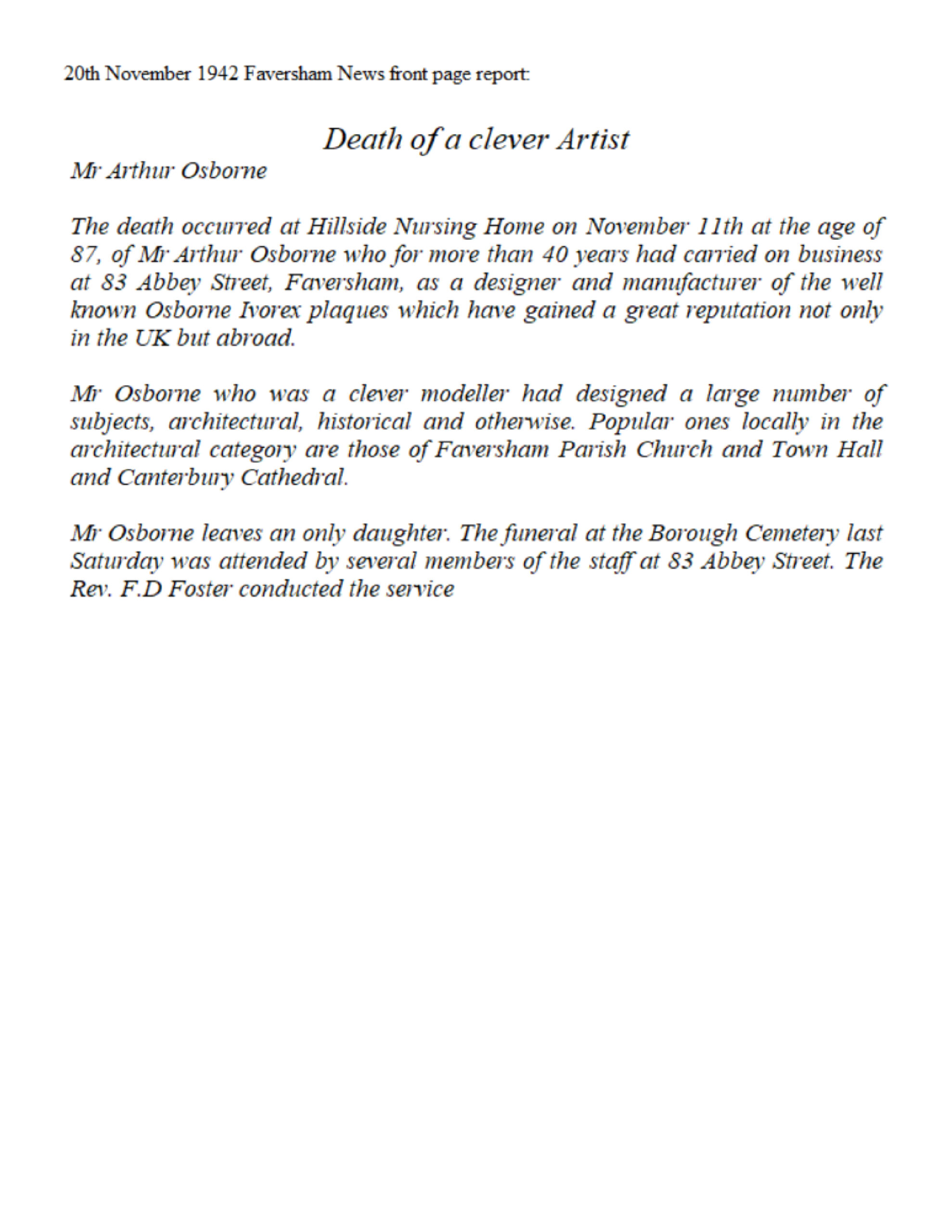
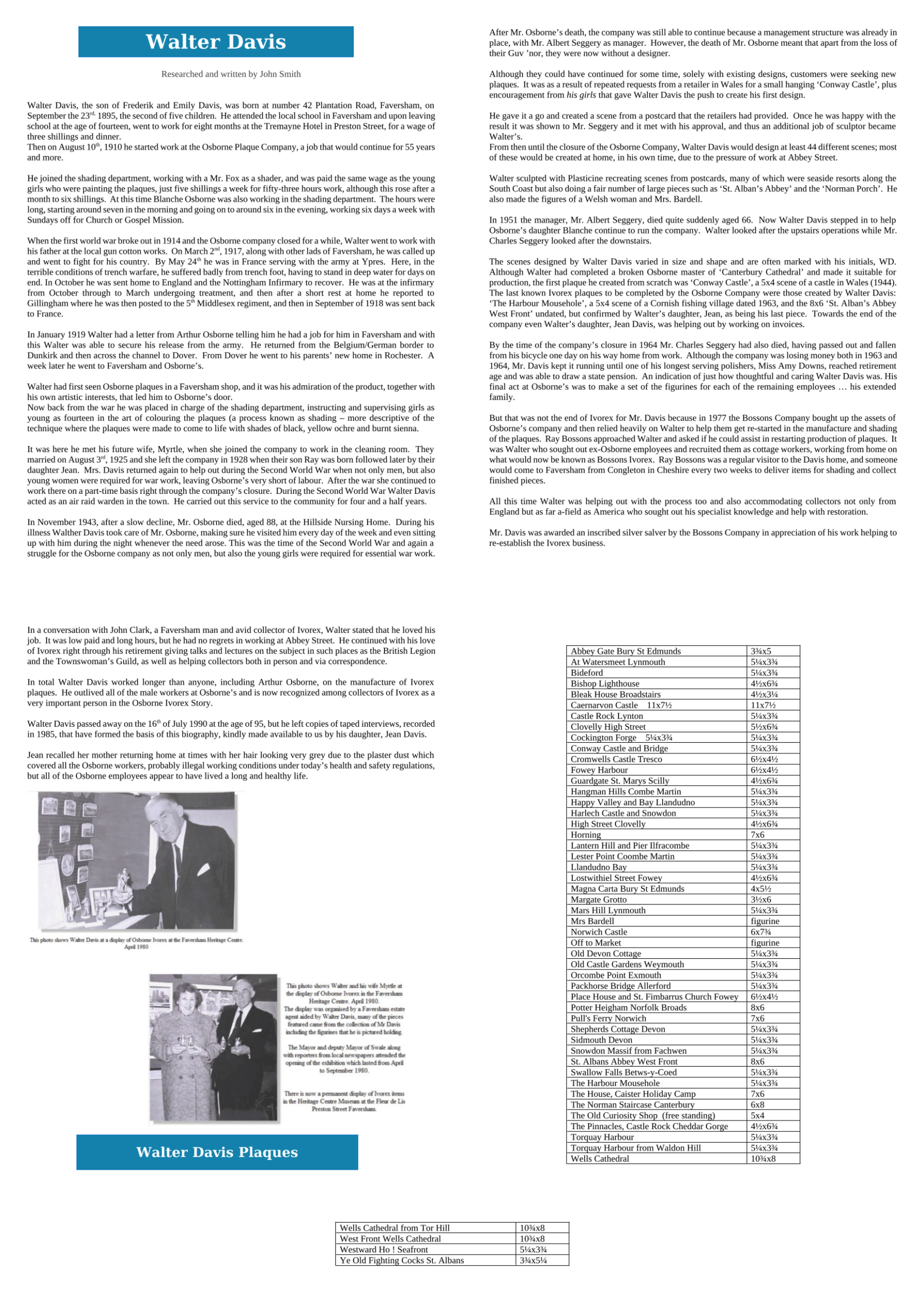
During the second world war the Osborne company kept going and the workers did their part for the war effort, but sadly Arthur Osborne died of pneumonia, aged 87, at the Hillside Nursing Home on November the 11th 1942, and on the 14th was buried as requested in an unmarked grave, known only as plot 112. But the business was carried on by his daughter Blanche, aided by the Manager Albert Seggery who was assisted by Walter Davis and Charles Seggery. New starters were still being taken on, and one of the young people employed in the shading department in 1944 was a local Faversham girl, named Eileen, and six years later in 1950, Jean was employed in the casting room.
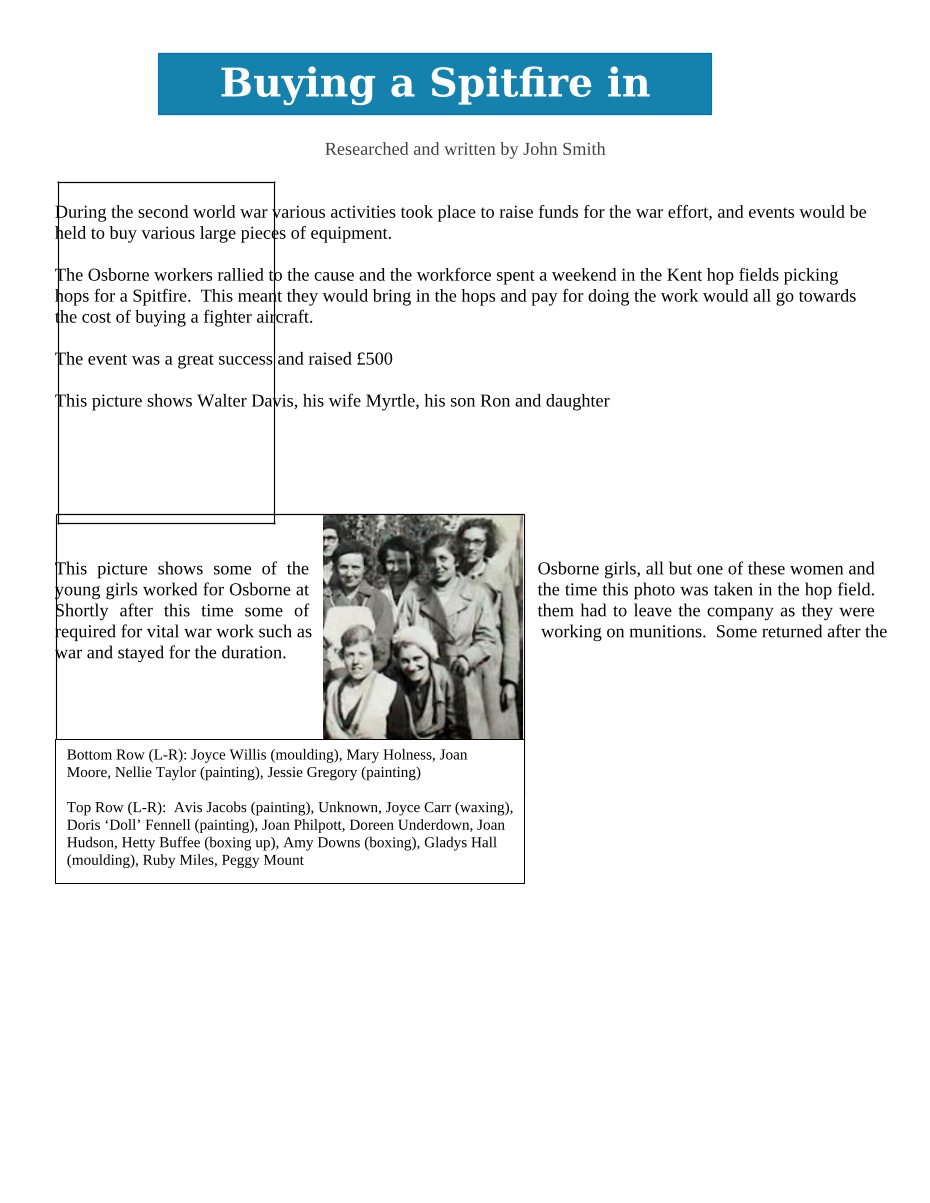
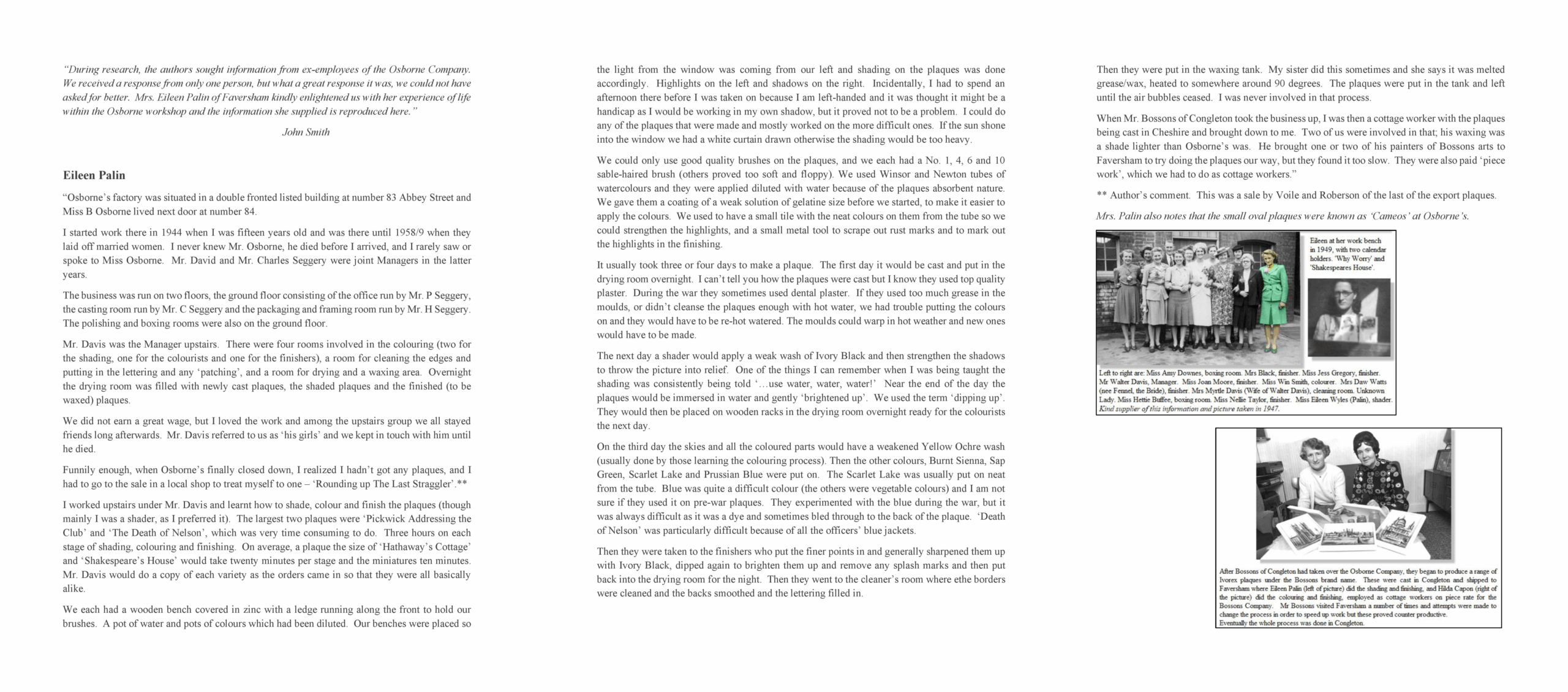
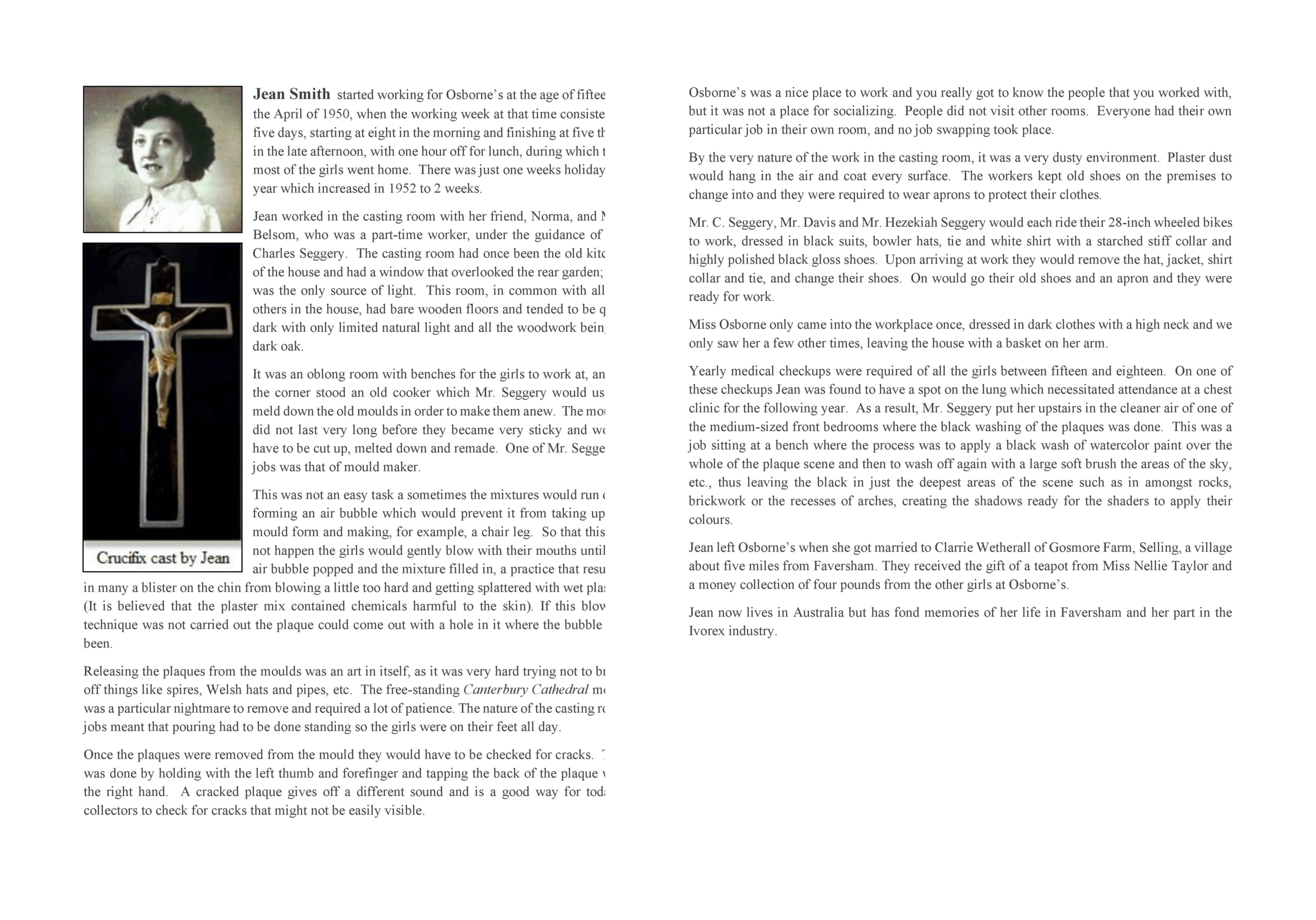
Following the second world war the demand for Ivorex was waning, taste in room decoration was changing and the cost of materials and labour were increasing, along with national insurance for employee’s there was the newly added burden of purchase tax, Ivorex being a non-essential item was rated for 125% purchase tax, this of course, more than doubled the price of every item made, and made small profits even harder to achieve, at the same time the North American market was beginning to decline as tastes, there too, changed. The Osborne Company gradually cut back production and in 1958/9 they laid off the married women to reduce labour costs, eventually in 1964 production ceased and they closed their doors. In the last two years of production the company ran at a loss
A number of retailers expressed dismay at the closure of Osborne’s, after having been able to sell their products with ease for a great many years, but all existing orders were now completed and it was time to call a halt. The local retailers Voile and Roberson, having bought a large supply of plaques in 1963 in order to boost their supply from the obviously ailing company, now took over the last of Osborne’s stock. A weak attempt was made by Cuthbert Dan, a second cousin of Blanche Osborne to re-start the plaque industry, but this failed and eventually the remaining moulds (many had been destroyed when the company closed and 83 Abbey Street had to be vacated) would be sold to someone else.
In 1971 the well-established company, Bossons, of Congleton Cheshire, plaque and character head makers, bought up the remaining assets of the B. Osborne Company from Blanche Osborne, Mr. Bossons having long been an admirer of Osborne’s work.
The Bossons company bought up all of the remaining Osborne moulds, although we do not know just how many moulds were still in existence at that time, it is known that many of the older ones were broken up by the Osborne company in order to re-use the Gelatine, and also many more were destroyed on the companies closure.
Bossons eventually produced a limited range of what would now be called Bossons Ivorex, at first using original moulds and sending the plaques to Faversham for painting by the original Osborne painters, later this was done in house by Bossons’ own staff. Bossons created new, more robust moulds for production, but retained the original Osborne Gelatine moulds. What happened to those for The Death of Nelson and the large Mr. Pickwick addressing the members. is unknown and Bossons never produced these extra-large pieces.
Ivorex plaques re-appeared for sale in Voile and Roberson’s, Faversham in 1977 priced £3.95 each.
The Bossons company closed in 1996, still with full order books, after a glorious history, producing character heads, plaques and ornaments that are widely sought by collectors today. Their nearest rival “Legend” continues in making their version of character heads, but “Ivorex” is no more.
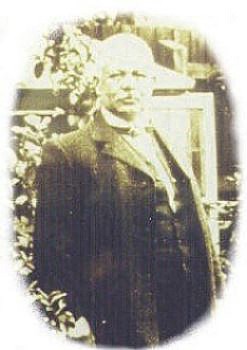
In his own way Mr. Osborne must have been a rather humble man, you won’t find his likeness portrayed in any of his plaques, when he could so easily have placed himself in one of his scenes, just as have many famous artists over the years. Only three photographs are known to have ever been taken of him, and his grave bears no head stone, strange when you consider that this man once carved beautifully ornate headstones for a living, but he was a practical person and he knew that money was tight, maybe he did not want to burden his daughter with this frivolous cost.
Certainly when his daughter Blanche, who had remained a spinster, died on January 31st 1973 aged 85 she followed in her father’s footsteps and was laid to rest in the same unmarked grave, with her father, in Faversham Cemetery.
Ivorex is now part of history, and is also a history lesson in itself, it shows us scenes from days gone by including some that through the ravages of war, no longer exist, they show us some fiction and a lot of fact, there is political satire, humour and religious devotion, many of the plaques reflecting a little of Arthur Osborne’s hidden personality, what was once a souvenir is now become a treasure, that will, we are sure, endure and be enjoyed long after we are gone.